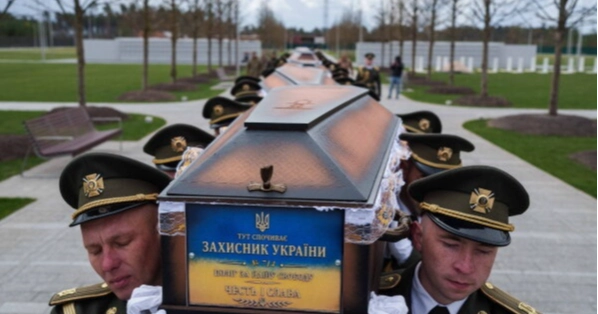
At a military cemetery in Kyiv, rows of crosses bear the words "Unknown Defender of Ukraine", each marked with an identification number and a note saying the identification process is still underway.
Among them is one grave that now carries a photograph of Ihor Yalynych, a Ukrainian soldier who went missing in the Kharkiv region in 2022. After searching for four years, his children, Stanislav and Oleksandra Yalynych, were finally able to find and identify their father's burial place.
The effort to identify thousands of soldiers killed in Russia's war is expected to continue for years, becoming one of the conflict's longest-lasting human tragedies. Many families are still waiting for confirmation, while some graves may never be identified.
For much of the war, Ukraine had no dedicated place to bury unidentified soldiers. Their bodies remained in refrigerated storage while the country's national military cemetery was under construction. Even before the cemetery officially opened in January, the first unidentified soldiers were buried there in August. Today, more than 300 graves carry only numbers instead of names, with more burials continuing.
"I was always close to my father, and losing him was very painful," said 21-year-old Oleksandra. "For four years, all I wanted was a place where I could come, sit with him and talk. Now I'm happy we found him."
A father's final mission
Ihor Yalynych was killed in eastern Ukraine in April 2022. He had served in the military since 2015, after fighting first broke out in eastern Ukraine and Russia illegally annexed Crimea in 2014.
When Russia launched its full-scale invasion in 2022, he was serving with a brigade in eastern Ukraine. He safely completed his first combat mission and even sent photos to his son. But he never returned from the second.
After weeks without contact, Stanislav posted online that his father was missing. Later, someone recognised Ihor in a photograph shared on a Russian Telegram channel showing nine dead Ukrainian soldiers lying side by side.
Ukraine's National Police in the Kharkiv region confirmed to AP that an investigation is ongoing into the deaths of the group of Ukrainian soldiers whose bodies were found there in April 2022, as well as efforts to identify them.
Although Ihor's body was recovered after Ukrainian forces retook the area in September 2022, his family spent four years dealing with official procedures, including DNA testing, before they could reclaim his remains.
Stanislav said the process was delayed because his father's case file was reportedly sent to police in Mykolaiv region, where Ihor was originally from, and remained unprocessed for more than two years.
In a written response to AP, Mykolaiv police did not comment on the family's claim that the file had been lost or delayed. They only said no criminal complaint had been filed regarding Ihor's identification.
Because of the missing file, Stanislav said he was only able to provide a DNA sample about six months ago. The match was confirmed two months later.
State keeps the flags until families are found
During military funerals in Ukraine, the national flag covering a soldier's coffin is normally folded and presented to the family.
For unidentified soldiers, however, there is no family member to receive it. Veterans Affairs Minister Natalia Kalmykova said the state accepts and keeps each flag until the soldier is identified.
She said honouring those who die defending the country is important not only for the fallen but also for those left behind, reminding Ukrainians of the price paid for their country's independence and democratic future.
Kalmykova said three of the first unidentified soldiers buried at the cemetery have since been identified.
She said one reason so many soldiers remain unidentified is that those who joined the military during the early years of the conflict were not required to provide DNA samples. Ukraine only created a DNA database later, and about half of the country's troops have now submitted samples, according to a senior military official who was not authorised to speak publicly.
When no DNA sample exists, identification depends on close relatives providing samples. Many relatives, however, remain in Russian-occupied areas, have left the country, are estranged from the soldier or cannot be located.
Since Russia's full-scale invasion began, more than 40,000 DNA samples from unidentified bodies have been registered, said Ruslan Abbasov, deputy director of the State Scientific Research Forensic Center under Ukraine's Interior Ministry. Most have now been matched with some of the 170,000 DNA samples collected from relatives.
When DNA samples are unavailable, investigators sometimes search a soldier's home or personal belongings to obtain genetic material.
Each unidentified body is buried with a unique identification number placed inside the coffin, marked on the outside and engraved on the grave's cross. Officials maintain a registry linking every number to the corresponding body, allowing graves to be located once a DNA match is confirmed.
A long process that will continue after the war
Bodies arrive from battlefields and through exchanges with Russia. Since the invasion began, Ukraine has brought home 24,805 bodies, according to the Coordination Headquarters for the Treatment of Prisoners of War.
Although many bodies are found carrying passports, military cards or driver's licences, DNA testing remains essential because investigators cannot be certain those documents belong to the deceased.
Forensic medical examiner Maksym Paziura said identification is often made more difficult because the remains of several people can sometimes be mixed together in a single bag. Most bodies are also in advanced stages of decomposition.
His office in the Kyiv region now processes between 15 and 20 bodies every day, storing them in refrigerated facilities until they are identified or buried. He said the workload has increased about five times compared with before the war.
"Even if the war ends, we will still have a huge amount of work," Paziura said. "Identification is a difficult and lengthy process that will continue long after the fighting stops."
For families, confirming a loved one's death is not only emotionally important. Without official identification, relatives cannot settle inheritance matters, remarry or receive government compensation provided to families of fallen soldiers.
Abbasov noted that countries in the Western Balkans are still identifying victims decades after their wars ended, adding that Ukraine is likely to face a similar challenge.
For Stanislav Yalynych, placing his father's photograph on the grave finally brought some peace.
"Now it won't only be us who know our father is buried there," he said. "People stop and ask about him. It means his sacrifice was not in vain, and he will be remembered."