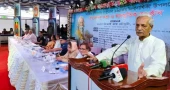
Cultural Affairs Minister Nitai Roy Chowdhury
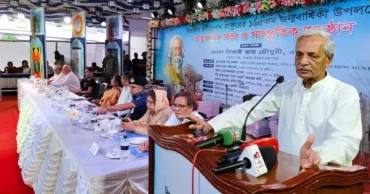
Rabindranath’s literature a powerful tool to remove darkness: Nitai Roy on his birth anniversary
Cultural Affairs Minister Nitai Roy Chowdhury has said the literature of Rabindranath Tagore is one of the most effective tools for removing darkness from society.
He said Rabindranath is the ray of sunlight in Bengali literature.
Just as sunlight dispels darkness, Rabindranath, through his timeless literary works, has illuminated and removed the darkness from our consciousness, he added.
The Minister made these remarks, while speaking as the chief guest at the inauguration ceremony of a three-day national celebration of the 165th birth anniversary of Rabindranath Tagore in Kushtia on Friday.
The event was organised by the Ministry of Cultural Affairs and implemented by the Kushtia District Administration at the historic Shilaidaha Kuthibari in Kushtia, a place deeply associated with the poet’s memories.
Nitai Roy Chowdhury, in his address, also said Rabindranath was, in every sense, a humanist and a compassionate advocate for farmers.
Referring to Shilaidaha as a living monument of Bengali literature and culture, he announced that the Ministries of Culture and Tourism would jointly work to transform the Kuthibari into a complete tourist destination.
Cultural Affairs Secretary Kaniz Moula presided over the event, while eminent educationist Professor Wakil Ahmed delivered a commemorative speech titled “Rabindranath: The Poet of Peace and Humanity.”
Members of Parliament Reza Ahmed Bacchu Molla, Afzal Hossain and Farida Yasmin, among others, were present.
The cultural affairs minister also visited the museum inside the Kuthibari and viewed the preserved memorabilia of the poet.
Later, the event was followed by cultural soiree on the open stage with an inaugural musical performance by Kushtia Shilpakala Academy artist Shreha Khatun.
The three-day festival features a variety of events, including Rabindra Sangeet performances, poetry recitations, dance, and drama, said a PID handout.
5 months ago
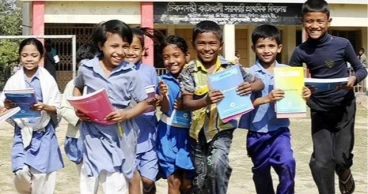
Music education to be introduced from primary to high school level: Minister
The government has decided to introduce music education alongside regular academic studies in educational institutions from primary to high school level, Cultural Affairs Minister Nitai Roy Chowdhury said on Tuesday.
He said the initiative will be implemented through the Ministry of Cultural Affairs using a cluster-based approach, under which music instructors will travel within upazilas to provide lessons across multiple institutions.
The minister made the remarks while speaking to journalists after attending a programme organised by the US Embassy at Dhaka University.
He said the government has already taken a decision to expand cultural activities at school level in every district and upazila.
“Alongside academic education, our ministry will ensure music education in all institutions, from primary to high school, through cluster-based outreach within upazilas,” he said.
He also noted that while the Ministry of Youth and Sports arranges sports competitions, similar music competitions are being organised to promote cultural engagement among students.
Replying to a question about the cancellation of music teacher appointments at upazila and district levels during the interim government, the minister said music teachers were not available in all institutions and were mostly concentrated in district-level schools.
He said the interim administration, not being an elected government, was not directly accountable to the people.
While the world embraces music education, Bangladesh seen stepping backwards
“During that period, some good decisions were made, along with some that, in our view, could have been avoided. However, I would not say those were intentional,” he added.
Responding to a query about whether this year’s Pahela Baishakh celebrations would be held under the name “Ananda Shobhajatra” or the traditional “Mangal Shobhajatra,” the minister said the government aims to uphold traditional values and cultural practices.
He also said that despite differences in ethnicity, identity, religion, caste and ideology, people in Bangladesh will continue to move forward in unity. “Political differences will remain, but people will continue to coexist within the same society,” he said.
6 months ago