Trump-Xi summit
Asian markets mixed as investors assess Trump-Xi summit
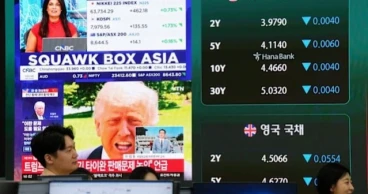
Asian stock markets closed mixed on Thursday, with Chinese shares falling as investors closely watched the outcome of U.S. President Donald Trump’s summit with Chinese President Xi Jinping in Beijing.
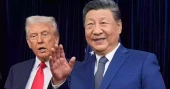
Trump and Xi met at the Great Hall of the People to discuss bilateral relations and Taiwan, but analysts said they did not expect any major breakthroughs.
Japan’s benchmark Nikkei 225 fell 1% to 62,654.05 after briefly hitting a new intraday record above 63,700, supported by strong corporate earnings.
South Korea’s Kospi rose 1.8% to a record close of 7,981.41, driven by strong gains in technology stocks amid continued enthusiasm over artificial intelligence.
In China, the Shanghai Composite Index dropped 1.5% to 4,177.92, while Hong Kong’s Hang Seng Index edged up 0.1% to 26,426.06.
Australia’s S&P/ASX 200 gained 0.1% to 8,640.70. Taiwan’s Taiex rose 0.9%, and India’s Sensex advanced 1%.
Oil prices moved higher as the conflict in Iran entered its third month with no clear end in sight, raising concerns over global energy supplies.
Some investors hoped the Trump-Xi meeting could help ease tensions, after U.S. officials said Beijing may use its economic ties with Tehran to encourage Iran to reopen the Strait of Hormuz, a vital shipping route for global oil exports.
Brent crude, the international benchmark, rose 0.3% to $105.95 per barrel. Before the Iran conflict began in late February, Brent was trading at around $70 per barrel.
U.S. benchmark crude gained 0.4% to $101.44 per barrel.
The International Energy Agency said on Wednesday that supply disruptions through the Strait of Hormuz were reducing global oil inventories at a record pace.
Investors were also monitoring developments involving Nvidia, as its CEO Jensen Huang joined Trump’s delegation to China along with Elon Musk of Tesla and Tim Cook of Apple.
On Wall Street, technology shares led gains overnight.
The S&P 500 rose 0.6% to a record 7,444.25. The Nasdaq Composite jumped 1.2% to an all-time high of 26,402.34, while the Dow Jones Industrial Average slipped 0.1% to 49,693.20.
In the bond market, the yield on the 10-year U.S. Treasury note eased to 4.46% from 4.47%, but remained well above the level seen before the Iran conflict began.
A report released Wednesday showed U.S. wholesale prices increased sharply in April, largely due to higher energy costs.
The U.S. Senate also confirmed Kevin Warsh as the next chair of the Federal Reserve, replacing Jerome Powell, who had faced criticism from Trump for not cutting interest rates more aggressively.
In currency trading, the U.S. dollar rose slightly to 157.92 Japanese yen from 157.86 yen. The euro was unchanged at $1.1711.
5 months ago
Trump-Xi summit to focus on trade, Taiwan and Iran
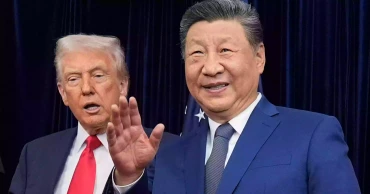
Chinese President Xi Jinping and US President Donald Trump are set to hold a closely watched summit, with both sides describing their recent ties as relatively stable while acknowledging that major challenges remain.
Despite expectations of continued dialogue, analysts say the meeting is unlikely to produce major breakthroughs, as longstanding tensions — from trade disputes to Taiwan and global security issues — remain unresolved.
“There is a shared understanding that stability in US-China relations is important, but what comes next is far more complicated,” said Henrietta Levin of the Center for Strategic and International Studies, adding that the meeting may yield limited concrete outcomes.
There may be a trade deal, but not a resolution
Trade tensions that began during Trump’s first term intensified last year when Washington imposed steep tariffs on Chinese imports, prompting retaliatory measures from Beijing, including restrictions on rare earth exports.
Tariffs escalated sharply before both sides agreed to a truce, suspending several punitive steps. During a previous meeting in South Korea, the two leaders extended the truce, with China pledging increased soybean purchases and the US reducing tariffs.
Experts say a new agreement could emerge from the summit, but it would likely come with conditions and fall short of ending the broader trade conflict.
“Both sides may reach a comprehensive deal, but that does not mean the trade war is over,” said Zhao Minghao, a professor at Fudan University.
Analysts also note that China has introduced new regulatory tools to counter foreign economic pressure, while the US continues targeted actions. The White House has indicated plans to discuss forming a “Board of Trade” to maintain economic dialogue.
China's ability to buy high-tech chips is still a thorny issue
Restrictions imposed by the US on exports of advanced semiconductors and related technologies remain a key sticking point.
American chipmaker Nvidia has urged Washington to ease limits, arguing that continued exports would maintain US technological influence over China’s growing artificial intelligence sector.
However, observers say Beijing is increasingly focused on strengthening its domestic chip industry, reducing reliance on US technology amid tightening controls.
China sees Taiwan as the ‘biggest risk’ in ties with the US
The issue of Taiwan continues to be the most sensitive point in bilateral relations.
Chinese Foreign Minister Wang Yi recently described Taiwan as the “biggest risk” in ties with Washington, a position reiterated ahead of the summit.
While China claims the island as its territory, Taiwan operates as a self-governed democracy. Tensions have escalated in recent years, with Beijing increasing military activities near the island.
The US, while maintaining strategic ambiguity, is legally bound to support Taiwan’s self-defense, further complicating the issue. Analysts suggest that a possible outcome could involve mutual restraint, such as reduced US arms sales in exchange for fewer Chinese military drills.
The US wants China to put pressure on Iran
The ongoing conflict involving Iran is also expected to feature in the discussions.
Washington is urging Beijing to use its influence over Tehran, particularly regarding the Strait of Hormuz, a vital global energy route.
US Treasury Secretary Scott Bessent recently called on China to step up diplomatic efforts, while also criticizing Beijing for its continued purchase of Iranian oil.
China, however, has taken a cautious stance, criticizing US actions in the Middle East but showing little willingness to play a direct mediating role.
“I don’t think China has any interest in solving the problems the U.S. has created for itself in the Middle East,” Levin, of the Center for Strategic and International Studies, said.
A few days before the trip, U.S. Treasury Secretary Scott Bessent called on China to pressure Iran to open the Strait of Hormuz, and said that by buying Iranian oil, Beijing is funding terrorism.
With multiple complex issues on the table, the summit is expected to focus more on managing tensions than resolving them, as both powers seek to maintain a fragile stability in their relationship.
5 months ago