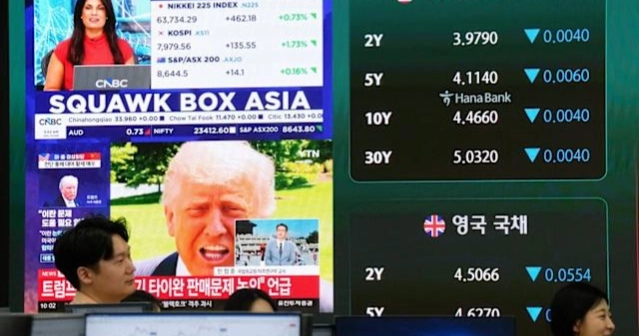
Asian stock markets closed mixed on Thursday, with Chinese shares falling as investors closely watched the outcome of U.S. President Donald Trump’s summit with Chinese President Xi Jinping in Beijing.
Trump and Xi met at the Great Hall of the People to discuss bilateral relations and Taiwan, but analysts said they did not expect any major breakthroughs.
Japan’s benchmark Nikkei 225 fell 1% to 62,654.05 after briefly hitting a new intraday record above 63,700, supported by strong corporate earnings.
South Korea’s Kospi rose 1.8% to a record close of 7,981.41, driven by strong gains in technology stocks amid continued enthusiasm over artificial intelligence.
In China, the Shanghai Composite Index dropped 1.5% to 4,177.92, while Hong Kong’s Hang Seng Index edged up 0.1% to 26,426.06.
Australia’s S&P/ASX 200 gained 0.1% to 8,640.70. Taiwan’s Taiex rose 0.9%, and India’s Sensex advanced 1%.
Oil prices moved higher as the conflict in Iran entered its third month with no clear end in sight, raising concerns over global energy supplies.
Some investors hoped the Trump-Xi meeting could help ease tensions, after U.S. officials said Beijing may use its economic ties with Tehran to encourage Iran to reopen the Strait of Hormuz, a vital shipping route for global oil exports.
Brent crude, the international benchmark, rose 0.3% to $105.95 per barrel. Before the Iran conflict began in late February, Brent was trading at around $70 per barrel.
U.S. benchmark crude gained 0.4% to $101.44 per barrel.
The International Energy Agency said on Wednesday that supply disruptions through the Strait of Hormuz were reducing global oil inventories at a record pace.
Investors were also monitoring developments involving Nvidia, as its CEO Jensen Huang joined Trump’s delegation to China along with Elon Musk of Tesla and Tim Cook of Apple.
On Wall Street, technology shares led gains overnight.
The S&P 500 rose 0.6% to a record 7,444.25. The Nasdaq Composite jumped 1.2% to an all-time high of 26,402.34, while the Dow Jones Industrial Average slipped 0.1% to 49,693.20.
In the bond market, the yield on the 10-year U.S. Treasury note eased to 4.46% from 4.47%, but remained well above the level seen before the Iran conflict began.
A report released Wednesday showed U.S. wholesale prices increased sharply in April, largely due to higher energy costs.
The U.S. Senate also confirmed Kevin Warsh as the next chair of the Federal Reserve, replacing Jerome Powell, who had faced criticism from Trump for not cutting interest rates more aggressively.
In currency trading, the U.S. dollar rose slightly to 157.92 Japanese yen from 157.86 yen. The euro was unchanged at $1.1711.