cut fuel imports
Call for prioritising distributed renewable energy to cut fuel imports
Bangladesh should prioritise distributed renewable energy, including rooftop solar and battery storage, to reduce dependence on imported fuels and strengthen energy security, Coordinator of the Distributed Renewable Energy Platform (DREP) Khondaker Golam Moazzem said on Sunday.
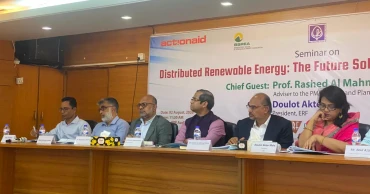
“Distributed renewable energy should be viewed as a distinct component of the country’s renewable energy strategy rather than being grouped with conventional utility solar and wind projects,” he said while speaking at a seminar titled “Distributed Renewable Energy: The Future Solar Solution for Bangladesh” organised by the Economic Reporters’ Forum (ERF) at its auditorium in collaboration with the DREP.
Prime Minister’s Adviser for Finance and Planning Rashed Al Mahmud Titumir attended the seminar as the chief guest.
Moazzem, also the Centre for Policy Dialogue (CPD) research director, said renewable energy discussions in Bangladesh generally focus on large-scale solar, wind or hydropower projects, but distributed renewable energy offers a different approach by generating electricity close to where it is consumed.
“Unlike utility-scale power plants that require vast tracts of land and extensive transmission infrastructure, distributed renewable energy systems can be installed on residential and industrial rooftops, agricultural land and other small sites,” he said.
Moazeem mentioned that electricity generated from these systems can either be consumed directly or supplied to the national grid through distribution networks.
He said such systems include rooftop solar installations under net metering, industrial rooftop solar, agrivoltaics, battery-backed renewable energy systems, solar home systems and solar-powered irrigation.
The DREP coordinator noted that one of the biggest advantages of distributed renewable energy is that it does not require large areas of land, addressing one of the common criticisms of utility-scale renewable energy projects.
Presenting data on the sector’s current capacity, he said Bangladesh now has around 213 megawatts (MW) of rooftop solar connected through net metering, while another 94 MW comes from rooftop solar systems outside the net metering scheme.
Solar home systems contribute around 263 MW, solar irrigation pumps 60 MW, while solar charging stations, drinking water systems and solar street lighting account for about 17 MW. Mini grids add another six MW.
Altogether, Bangladesh has around 655 MW of distributed renewable energy capacity, Moazzem said.
He said the sector has significant growth potential as industries increasingly turn to rooftop solar because of gas shortages and rising energy costs. “The country’s energy crisis is unlikely to disappear soon, while reliance on imported fuel will become increasingly expensive. Therefore, Bangladesh must expand the use of domestic energy resources, including renewable energy and rooftop solar,” he said.
The CPD research director said energy-efficient technologies, battery storage and rooftop solar will play a growing role across industries, agriculture, transport, households and healthcare facilities.
Electric vehicles, battery systems, solar irrigation, mini grids and electric cooking appliances are also expected to become more widespread in the coming years, he added.
Moazzem also announced that the Distributed Renewable Energy Platform, launched in July 2025, will work on policy research, legal and regulatory reforms, technology development, financing mechanisms and community-level expansion of distributed renewable energy across the country.
The platform currently comprises five member organisations: ActionAid Bangladesh, Bangladesh Solar & Renewable Energy Association (BSREA), CPD, Coastal Livelihood and Environmental Action Network (CLEAN) and SOLshare.
The platform will also engage with the government, private sector and development partners while drawing lessons from countries such as China and Vietnam to accelerate the adoption of distributed renewable energy in Bangladesh.
2 months ago