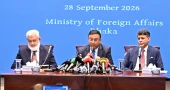
State Minister for Foreign Affairs Humaiun Kobir
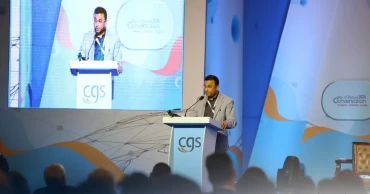
Rebuilding trust among states essential for effective cooperation: Dhaka
State Minister for Foreign Affairs Humaiun Kobir on Monday said rebuilding trust among states is essential for effective international cooperation, stressing that without trust, partnerships weaken.
“We must address the challenge of trust. Without trust, partnerships weaken. Without trust, institutions lose credibility. Without trust, diplomacy becomes more difficult and challenging,” he said, noting that Bangladesh believes in dialogue, international law, and peaceful settlement of disputes.
Speaking at the Bay of Bengal Conversation, the State Minister said Bangladesh believes in a rules-based international order that respects the sovereignty and dignity of every state.
He also called for diplomatic institutions to adapt to emerging technologies and new forms of global competition.
Prime Minister Tarique Rahman inaugurated the three-day international conference on Saturday which ended on Monday.
The State Minister said Bangladesh seeks to pursue an independent and pragmatic foreign policy focused on national interest, strategic autonomy, economic opportunity and peace amid growing geopolitical competition.
“Bangladesh should not simply navigate the changing international order. Bangladesh should help shape it and influence it. We should be a bridge between regions, a partner for peace, a hub for connectivity, a destination for investment and a responsible voice for the global South,” he said.
Kobir said their foreign policy must be confident, pragmatic, and forward looking. “It must protect our national interest without closing the door to cooperation and dialogue. It must expand our partnerships without creating dependency.”
And above all, he said, it must serve the people of Bangladesh. The State Minister shared four principles and said, “National interests must guide us. Strategic autonomy must strengthen us. Partnership must expand our opportunities, and peace must remain our ultimate objective.”
The State Minister said the future will not wait for them. “We must shape it, and we must ensure that Bangladesh is a meaningful voice in that future.”
“Our foreign policy must serve Bangladesh’s national interest,” he said, noting that Bangladesh’s foreign policy must protect its sovereignty and security while creating the external conditions necessary for national development.
“We seek engagement with all, based on mutual respect, mutual benefit and national interest. We want strong partnerships, but we also want strategic autonomy. We want cooperation, but we do not want dependency,” Kobir said.
The State Minister said the global order is undergoing rapid changes, with shifting power dynamics, technological transformation and increasingly strategic economic competition putting pressure on trust among states.
“Foreign policy must do more than respond to change. It must help Bangladesh shape the future,” he said.
Kobir said the Bay of Bengal is at the centre of the changing geopolitical landscape and Bangladesh must turn its geographic position into a strategic opportunity.
“The Bay of Bengal connects South Asia and Southeast Asia. It connects major markets, vital sea routes and growing economies,” he said.
Bangladesh wants the Bay of Bengal to remain a space for peace, stability and cooperation, rather than becoming a theatre of confrontation, he said.
The State Minister also stressed the need for Bangladesh to maintain constructive relations with major powers and regional partners without viewing international relations as a choice between competing camps.
“Our policy is not to choose sides. Our policy is to choose what is best for the national interest of Bangladesh,” he said.
“When interests converge, we will cooperate. Where opportunities exist, we will engage. Where differences arise, we will manage them. That is diplomacy. This is strategic maturity in an age of competition,” Kobir said.
He said foreign policy and economic policy can no longer be treated separately, as markets, supply chains, energy, technology and investment are increasingly linked to national security and development.
“Economic diplomacy must be a core instrument of Bangladesh’s foreign policy,” he said.
“For a country like Bangladesh, foreign policy, economic policy and security policy cannot be too separated from each other. It must take shape and formulation in an integrated way,” Kobir said.
The State Minister said South Asia remains one of the least integrated regions in the world and called for stronger regional connectivity, trade, energy cooperation and people-to-people contacts.
Bangladesh should be more ambitious in pursuing regional economic integration, including exploring the possibility of greater market access and a potential regional single market, he said.
“These are ambitious goals. But we need to put ourselves in that vision,” Kobir said.
He also highlighted non-traditional security challenges, including cyber, food, energy, water and maritime security, saying these challenges cross borders and require greater regional cooperation.
Bangladesh needs a security architecture that strengthens resilience, policy coherence and delivery, he said.
Kobir said climate change and humanitarian displacement remain major challenges for Bangladesh, which contributes very little to global emissions but faces severe climate risks.
He called for greater climate justice, adaptation finance, technology transfer and international cooperation.
“Climate leadership was the priority that we placed,” he said, referring to the government’s engagement at the World Economic Forum.
The Rohingya crisis, meanwhile, remains one of Bangladesh’s top national security and foreign policy priorities, Kobir said.
Bangladesh continues to host more than one million forcibly displaced Rohingyas and has carried the responsibility with “humanity and dignity,” he said.
“But humanitarian assistance cannot be the permanent answer to this crisis. It is a major and serious problem of political and security concern that needs to be addressed,” he said.
Kobir said Bangladesh would seek to raise the profile of the Rohingya issue at the international and multilateral levels during its presidency of the 81st session of the UN General Assembly.
The country would also seek greater financial support and intensify bilateral engagement with development partners in the region and beyond to help resolve the crisis, he said.
“The ultimate objective must be the safe, voluntary, dignified and sustainable return of the Rohingya people,” Kobir said, stressing the need for sustained international political commitment.
“Artificial intelligence will transform diplomacy. Digital technologies will reshape economies. Climate change will shape security. New technologies will reshape warfare,” Kobir said.
Bangladesh needs stronger strategic analysis, greater technological expertise and deeper economic knowledge, while its next generation of diplomats must be able to understand geopolitics, economics, technology, climate and security in an integrated manner, he said.
5 days ago
No hidden agenda behind Boeing deal: State Minister Kobir
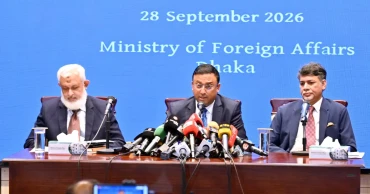
State Minister for Foreign Affairs Humaiun Kobir on Monday said there is no hidden agenda behind the latest agreement signed with Boeing, reiterating that Bangladesh will continue to expand Biman’s fleet based on needs as the country eyes becoming an aviation hub.
“It was done through a signing ceremony in a very open environment. As per our requirements, we are purchasing Boeing. The (existing) fleet needs to be expanded in a big way. This is nothing. There is no hidden agenda in it,” he told reporters at the Ministry of Foreign Affairs while responding to a question.
The State Minister said they need to expand the fleet to become an aviation hub and Bangladesh does it on the basis of needs. Kobir laid emphasis on a mixed aircraft fleet in the interest of the country’s aviation sector.
Secretary (Intergovernmental Organizations) M. Forhadul Islam and Additional Foreign Secretary (Public Diplomacy and Other Priority Matters) AKM Shahidul Karim were also present at the media briefing.
The State Minister described the just-concluded visit of Prime Minister Tarique Rahman to the 81st session of the UNGA as "successful and meaningful," with extensive engagements with the international community during his four-day stay in New York.
Kobir said the speech of the Prime Minister at the UNGA was highly appreciated by the international community.
“So, it was a very holistic speech that encapsulated all areas of domestic, national and international moments of interest,” said the State Minister, adding that Bangladesh's participation in the 81st session of the United Nations General Assembly (UNGA) has been successful.
“This visit not only provided an opportunity to present the new government's commitments to the global community but also created a significant opening to expand bilateral and multilateral cooperation,” he said.
Kobir said everyone expressed full support for Bangladesh's new democratic journey. “After such a long time, a Prime Minister elected through the direct vote of the people has elevated Bangladesh's self-confidence and stature to new heights on the global stage.”
Biman Bangladesh Airlines, the country's national flag carrier, signed an agreement with US aircraft manufacturer Boeing to acquire 11 additional aircraft during Prime Minister Tarique Rahman’s visit to New York for the 81st session of the United Nations General Assembly.
"Congratulations to Boeing and Biman on the agreement to purchase 11 more of the world’s best commercial planes. Another win-win for the U.S.-Bangladesh relationship! Will be tuning in to the signing ceremony in New York later," said US Ambassador to Bangladesh Brent T Christensen moments before the signing ceremony.
In April, Bangladesh signed a deal with US aircraft manufacturer Boeing to buy 14 planes for its national carrier Biman Bangladesh Airlines, the two sides announced - the airline’s biggest-ever order, in a deal valued at $3.7 billion.
A journalist sought comments from the State Minister referring to remarks made by a leader from the opposition party who claimed that the Prime Minister’s speech focused solely on the party and served to glorify it, lacking any fundamental discourse on behalf of the nation.
“Honestly, I am astonished at the logic behind such remarks! Climate change was a primary focus of the Prime Minister's speech. Is climate change an issue specific to the BNP or Jamaat? It is a matter concerning the entire nation and is a crucial issue for the world,” Kobir said, adding that he failed to understand how it could be construed as a partisan statement.
The State Minister said it is not right to make comments without understanding, reading, or listening to the facts.
He said the Prime Minister spoke about various domestic policies, international peace and stability, and the Palestine and Rohingya crises. “Are these merely party issues? He addressed the entire world. It was a comprehensive and highly significant speech that covered matters of both national and international interest. Therefore, these comments have no basis in logic.”
Responding to a question, Kobir said while other heads of government from around the world typically visit for two days, the Prime Minister stayed for four days and participated in nearly 30 meetings.
“The visit was entirely in accordance with the United Nations' pre-scheduled programme, so the question of cutting it short does not arise. He returned home on schedule after completing his work,” he said.
Asked about the Dhaka-New York flight, the State Minister said it had been suspended primarily due to technical and safety assessment issues. “We have initiated the process for a technical and safety reassessment. Once this is completed, we hope it will be possible to resume the flights.”
13 days ago
No scope for Bangladesh to join BRICS Summit; PM wasn’t invited: Humaiun Kobir
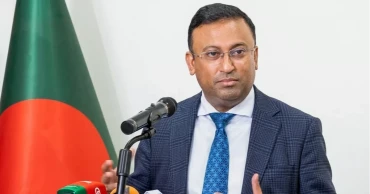
State Minister for Foreign Affairs Humaiun Kobir on Thursday said there is no scope for Bangladesh to send a government representative to the BRICS Summit, as Prime Minister Tarique Rahman was not invited to the summit and the invitation was instead extended to the BIMSTEC Chair.
“How shall we go? Has anyone from the Bangladesh government been invited? Our Prime Minister was not invited. Who told you that our Prime Minister was invited? The BIMSTEC Chair was invited. Then why are you asking this question?” he told reporters, ruling out the possibility of Prime Minister Tarique Rahman attending the BRICS Summit.
Responding to a question at the Foreign Service Academy, Kobir said Prime Minister Tarique Rahman’s first visit to India cannot be a multilateral visit.
He said the government is working on arranging a bilateral visit to India when the timing is conducive, stressing that Bangladesh is placing greater emphasis on a bilateral visit by the Prime Minister and discussions.
Kobir said such a bilateral visit will take place when the environment is conducive and mutual respect is maintained. “There is no need to rush things.”
Responding to a question about the renewal of the Ganges Water Treaty, the State Minister said, “Wherever our national interest is involved, we will act with importance and competence. We will prioritise the interests and well-being of our country.”
In April 2025, Bangladesh assumed the chairmanship of the regional grouping - Bay of Bengal Initiative for Multi-Sectoral Technical and Economic Cooperation (BIMSTEC) - for the next two years, reaffirming its commitment to advancing regional cooperation and development.
BIMSTEC consists of seven member countries, namely Bangladesh, Bhutan, India, Myanmar, Nepal, Sri Lanka and Thailand.
On August 4, India confirmed that an invitation had been extended to Prime Minister Tarique to attend the BRICS Summit as the BIMSTEC Chair, while a separate bilateral invitation has been in place since February this year.
“You would be aware that a formal invitation to Bangladesh Prime Minister Tarique Rahman to visit India was extended when he assumed office in February 2026,” said Ministry of External Affairs (MEA) Spokesperson Randhir Jaiswal during a media briefing in New Delhi recently.
As far as the BRICS Summit is concerned, he said India has separately extended an invitation to the Bangladesh Prime Minister in his capacity as the current Chair of BIMSTEC to attend the outreach session of the 18th BRICS Summit in New Delhi.
“The invitation has been extended as per the standard practice being followed in BRICS for the outreach sessions. Other heads of regional groups have also been invited in a similar manner,” the MEA spokesperson said.
BRICS member states and United Nations Secretary-General António Guterres will attend the 18th BRICS Summit to be held in New Delhi, India, on September 12-13.
The United Nations in India confirmed his participation in a post on its verified Facebook page on Wednesday.
As BRICS Chair 2026, India will host the 18th BRICS Summit at Bharat Mandapam in New Delhi.
The Summit will bring together leaders of BRICS member and partner countries, as well as outreach invitees.
India’s BRICS Chairship is guided by the theme: “Building for Resilience, Innovation, Cooperation and Sustainability,” reflecting Prime Minister Narendra Modi’s vision of a people-centric approach rooted in the spirit of “Humanity First.”
In addition to these areas, the leaders will exchange views on strengthening intra-BRICS cooperation on common priorities and share perspectives on global and regional matters of mutual importance.
Under India’s Chairship this year, over 350 meetings and high-level engagements have been held in over 25 cities across India to further strengthen the BRICS strategic partnership across three fundamental pillars: political and security, economic and financial, and cultural and people-to-people exchanges, said the host country.
Through these engagements, as well as business-to-business and people-to-people initiatives, India’s BRICS Chairship has contributed to advancing BRICS cooperation through practical and development-oriented outcomes.
India is a founding member of BRICS and has previously held its Chairship three times, in 2012, 2016 and 2021. India assumed its fourth BRICS Chairship on January 1, 2026.
The year 2026 also marks a significant milestone as BRICS completes 20 years since its establishment.
1 month ago
Hormuz Strait’s reopening doesn’t depend on one party; multiple actors involved: Dhaka
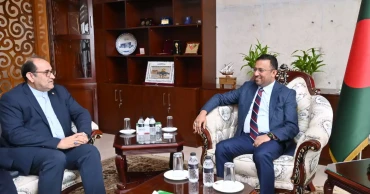
State Minister for Foreign Affairs Humaiun Kobir on Wednesday said keeping the Strait of Hormuz open does not depend on just one single party, stressing that there are a range of complex issues involved and multiple actors are engaged in the conflict.
“Look, keeping the Strait of Hormuz open does not depend on the decision of any single party. There are a range of complex issues involved, and multiple parties are directly or indirectly engaged in the conflict in the region. So, it is not a matter of isolating one party and depending on that one party to decide whether the strait will remain open or closed. That is not the case,” he told reporters at the Ministry of Foreign Affairs.
The State Minister said Bangladesh has reiterated its call for de-escalation of the conflict in the Middle East and sought a solution to the problem through dialogue under a de-escalation framework.
Kobir expressed Bangladesh’s hope for an early end to tensions in the region and lasting peace and stability in the interest of the people of the region and beyond.
He also highlighted the longstanding historical ties between Bangladesh and Iran, saying people-to-people exchanges and bilateral relations between Dhaka and Tehran date back to the period following Bangladesh’s independence. The two sides also exchanged views on cultural cooperation, he said.
Iran conveyed to Bangladesh that there is “no problem and difficulty” from Iran’s side regarding the shipment of LNG, gas and fuel to Bangladesh, while blaming the US for creating difficulties surrounding energy supplies.
“From the side of Iran, there is no problem and difficulty for shipment of your LNG, gas and fuel,” Ambassador of Iran to Bangladesh Dr Jalil Rahimi Jahanabadi told reporters at the Ministry of Foreign Affairs while responding to questions from journalists.
Earlier, he paid a courtesy call on State Minister-1 for Foreign Affairs Humaiun Kobir. During the meeting, they discussed issues of mutual interest.
The Iranian envoy identified what he described as two major realities behind the continuation of the difficulties - the impact of US attacks and the continuation of what he called the American blockade against Iran.
“From the side of Iran, there’s no problem. The problem is caused by Americans,” the Ambassador said.
Bangladesh stressed that the safety and wellbeing of some 8 million Bangladeshis living and working across the region remain a top priority.
The State Minister discussed recent developments and the ongoing conflict in the Middle East, along with the safety of Bangladeshi nationals and the movement of Bangladesh-bound cargo.
“We have reiterated our call for de-escalation. This has always been our consistent diplomatic position - to seek de-escalation of the conflict,” Kobir said.
He said Bangladesh has urged all sides to engage in dialogue, resolve their differences through diplomatic means and work toward a permanent and peaceful resolution.
“As you know, we have a large diaspora in the Middle East - approximately 8 million people of Bangladeshi origin working throughout the region. Their well-being and safety are of paramount importance to us,” he said.
Kobir said Bangladesh would continue to work with countries in the region on issues affecting its relations with the Middle East, particularly the safety of Bangladeshi citizens.
He expressed gratitude to Iran for helping Bangladesh evacuate some of its citizens who had been stranded in Tehran.
“On behalf of the Prime Minister (Tarique Rahman), I expressed our gratitude to them and appreciated their supportive initiatives,” the State Minister said.
The meeting also covered Bangladesh’s security cooperation and defence-related engagements in the Middle East, including its long-standing maritime cooperation with Saudi Arabia in addressing security challenges posed by the Houthis.
“This cooperation is vital because the Kingdom of Saudi Arabia is the custodian of the two holy mosques. Iran understands our position clearly in this regard,” Kobir said.
He, however, made Bangladesh’s position regarding the conflict with Iran clear.
“Our position is clear: we do not support, participate in, or call for any aggression or attacks against Iran,” he said.
“Our role is strictly limited to supporting Saudi Arabia in addressing the security challenges posed by the Houthis,” Kobir added.
The State Minister said Bangladesh also requested that its stranded cargo containers be given priority once a peaceful resolution is reached and the situation surrounding the Strait of Hormuz is de-escalated.
Asked about the movement of Bangladeshi ships and energy vessels affected by the disruption, Kobir said the situation was affecting vessels from many countries, not Bangladesh alone.
“It is not just Bangladesh; vessels from many nations across the world are currently affected,” he said.
“However, regarding Bangladesh's specific interests, we conveyed that as soon as the Strait of Hormuz reopens, our shipments and containers should be facilitated and prioritized as early as possible,” Kobir said.
1 month ago
Bangladesh asks for LNG supplies from Qatar to be prioritised
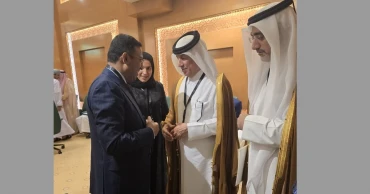
Bangladesh on Thursday requested Qatar to accord priority to the supply of LNG to Bangladesh as soon as the Strait of Hormuz reopens and maritime movement resumes.
State Minister for Foreign Affairs Humaiun Kobir met with Qatar’s Minister of State for Foreign Affairs Sultan bin Saad Al-Muraikhi on the sidelines of the 23rd OIC Extraordinary CFM in Jeddah and made the request.
The State Minister reaffirmed Bangladesh’s support for Qatar’s mediation efforts between Iran and the United States and commended Qatar’s constructive role in promoting dialogue and regional peace and stability.
The Qatari State Minister thanked Bangladesh for its support and expressed Qatar’s readiness to further strengthen cooperation in the energy sector.
They also discussed some other bilateral issues, according to the Ministry of Foreign Affairs.
1 month ago