Bangladesh’s future economy
Blue economy can become key driver of Bangladesh’s future economy: Education Minister
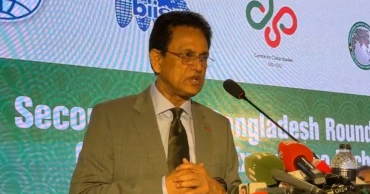
Education Minister Dr ANM Ehsanul Hoque Milon on Monday said blue economy could emerge as a key sector of Bangladesh’s future economy and it has a huge scope for research, education and resource development.
He also said the government has planned to establish a university specialising in the blue economy, where Bangladesh and China could work together, the minister said at the second China-Bangladesh Administrative Experience Exchange Roundtable held at a hotel in the capital.
The event was jointly organised by the University of Dhaka’s Centre for China Studies and the Shanghai Institutes for International Studies.
Milon said friendship between Bangladesh and China has continued for a long time and has never stopped. “Whether it is sunny, cloudy, windy, rainy or stormy, the relationship with China goes on and on. The continuation of this effort is going on now.”
He said China was once highly populated and its population became a resource for the country, contributing to its present position in the global economic sector.
“We also have a large population but no resources, we feel it. But if we compare with China, yes, of course, we can see and we can go ahead and we can see our future through the resource. Number one resource is population,” he said.
He said this is the time to reap the demographic dividend.“The other resource is the blue economy,” he said.
Milon said Bangladesh has an exclusive zone of 200 nautical miles and a continental shelf extending to about 560 kilometres/nautical miles, describing the area as part of the country where resources are available.
The minister said Chinese experts, professors and researchers are now looking into the sector, and the blue economy is one of the important sectors for research and education in Bangladesh.
He said Prime Minister Tarique Rahman is also talking about the issue.
Turning to human resources, Milon said developing human capital is another major resource and the most important area for Bangladesh. “This population should be converted into manpower,” he said.
He said young people and working people constitute nearly 65 percent of the country’s population, while Bangladesh has a population of about 180 million.
He said Bangladesh is in an advantageous position as more people are dying and fewer people are being born in Western countries, while Bangladesh has the opposite demographic trend, with more people being born and fewer people dying.
“This is our main resource,” he said, adding that the world is now facing population scarcity, particularly in the Western world, while China’s population is also not growing at the same rate in accordance with its development.
“We must address, we must address this sector. And here we are now to address this sector,” he said.
He said Prime Minister Tarique Rahman has committed to providing further budgetary support to the education sector. “This year I received 2 percent of net GDP. And he wishes to contribute up to 5 percent of GDP,” he said.
Calling it a huge amount of the budget, the minister questioned where the additional allocation should be invested.
He thanked the Chinese government for extending ideas and research cooperation with Bangladesh in the two specific sectors, blue economy and disaster management, prevention and reduction.
Milon said Bangladesh needs to build a long-term bridge of friendship with China and expressed the view that the bridge could be built through education.
“We need to build a bridge, the friendship long term with China and I believe this bridge could be built through education, only education and only education,” he said.
He said such cooperation would prolong the friendship between the two countries.
21 days ago