Turkey Kurdish leader
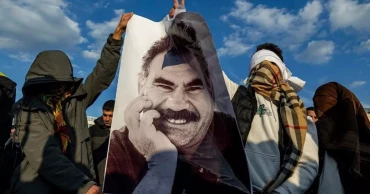
Turkey relocates Kurdish leader Ocalan within island prison amid peace efforts
Turkey has transferred Kurdish militant leader Abdullah Ocalan to a newly constructed section of an island prison where he has been held since 1999, as part of ongoing efforts to end decades of conflict, a senior Kurdish politician said.
Better prison conditions for Ocalan, the leader of the Kurdistan Workers' Party (PKK), have been a longstanding demand of Kurdish representatives seeking to resolve the 42-year conflict between the group and Turkish authorities.
Ocalan has been imprisoned on Imrali Island in the Marmara Sea, which connects the Black Sea with the Aegean Sea, since his capture in 1999.
Mithat Sancar, a lawmaker from the pro-Kurdish DEM Party, confirmed the transfer in an interview with Medya Haber TV on Saturday but did not disclose further details.
Although Sancar did not explicitly say whether the new facility offers improved living conditions, his comments appeared to suggest that it does.
He also urged authorities to accelerate the peace process, saying it had remained "on a pause" for the past two months.
According to Sancar, Ocalan's transfer to the new facility "necessitates an acceleration of the (peace) process."
Sancar is among DEM Party politicians who have regularly visited Ocalan since the Kurdish leader called on the PKK to dissolve itself and surrender its weapons in February 2025.
Despite his imprisonment, Ocalan remains an influential figure among Kurds and is considered central to efforts to advance the peace process.
In May 2025, the PKK announced its decision to disarm and end its armed campaign. Subsequently, the Turkish parliament passed legislation in August offering conditional pardons to thousands of PKK fighters. President Recep Tayyip Erdogan later signed the legislation into law.
The conflict, which began in 1984, has claimed tens of thousands of lives. Turkey, the United States and the European Union designate the PKK as a terrorist organisation.
Sancar emphasised that Ocalan, who co-founded the PKK in the 1970s, must play a coordinating role in peace negotiations.
"The process cannot proceed with unilateral expectations and demands," he said, urging the Turkish government to abandon what he described as its "insistent and rigid stance."
1 hour ago