Middle-East
Israeli strikes in Syria leave 14 dead and more than 40 wounded, Syrian state media says
The number of people killed in overnight Israeli strikes in Syria has risen to 14 with more than 40 wounded, Syrian state media said Monday morning.
Israeli strikes hit several areas in central Syria late Sunday, damaging a highway in Hama province and sparking fires, Syrian state news agency SANA said. The initial death count reported by the Masyaf National Hospital in western Hamas province was four.
SANA, citing hospital head Faysal Haydar, said 14 were killed and 43 wounded. The Syrian Observatory for Human Rights, a U.K.-based war monitor, said at least four of those killed were civilians.
One of the strikes targeted a scientific research center in Maysaf and others struck sites where “Iranian militias and experts are stationed to develop weapons in Syria,” the Syrian Observatory for Human Rights said. Local media also reported strikes around the coastal city of Tartous.
There was no immediate comment from the Israeli military. Israel has carried out hundreds of strikes on targets inside government-controlled parts of war-torn Syria in recent years, but it rarely acknowledges or discusses the operations. The strikes often target Syrian forces or Iranian-backed groups.
Israel has vowed to stop Iranian entrenchment in Syria, particularly since Syria is a key route for Iran to send weapons to the Lebanese militant group Hezbollah.
Hezbollah has been clashing with Israeli forces for the past 11 months against the backdrop of Israel’s war against Hamas — an ally of Hezbollah — in Gaza.
1 year ago
Chased away by Israeli settlers, these Palestinians returned to a village in ruins
An entire Palestinian community fled their tiny West Bank village last fall after repeated threats from Israeli settlers with a history of violence. Then, in a rare endorsement of Palestinian land rights, Israel’s highest court ruled this summer the displaced residents of Khirbet Zanuta were entitled to return under the protection of Israeli forces.
But their homecoming has been bittersweet. In the intervening months, nearly all the houses in the village, a health clinic and a school were destroyed — along with the community’s sense of security in the remote desert land where they have farmed and herded sheep for decades.
Roughly 40% of former residents have so far chosen not to return. The 150 or so that have come back are sleeping outside the ruins of their old homes. They say they are determined to rebuild – and to stay – even as settlers once again try to intimidate them into leaving and a court order prevents them from any new construction.
“There is joy, but there are some drawbacks,” said Fayez Suliman Tel, the head of the village council and one of the first to come back to see the ransacked village – roofs seemingly blown off buildings, walls defaced by graffiti.
“The situation is extremely miserable,” Tel said, “but despite that, we are steadfast and staying in our land, and God willing, this displacement will not be repeated.”
The Israeli military body in charge of civilian affairs in the West Bank said in a statement to The Associated Press it had not received any claims of Israeli vandalism of the village, and that it was taking measures to “ensure security and public order” during the villagers’ return.
“The Palestinians erected a number of structural components illegally at the place, and in that regard enforcement proceedings were undertaken in accordance with law,” the statement said.
The villagers of Khirbet Zanuta had long faced harassment and violence from settlers. But after the Oct. 7 attack on Israel by Hamas that launched the war in Gaza, they said they received explicit death threats from Israelis living in an unauthorized outpost up the hill called Meitarim Farm. The outpost is run by Yinon Levi, who has been sanctioned by the U.S., UK, EU and Canada for menacing his Palestinian neighbors.
The villagers say they reported the threats and attacks to Israeli police, but said they got little help. Fearing for their lives, at the end of October, they packed up whatever they could carry and left.
Though settler violence had been rising even before the war under the far-right government of Prime Minister Benjamin Netanyahu, it has been turbocharged ever since Oct. 7. More than 1,500 Palestinians have been displaced by settler violence since then, according to the United Nations, and very few have returned home.
Khirbet Zanuta stands as a rare example. It is unclear if any other displaced community has been granted a court's permission to return since the start of the war.
Even though residents have legal protection Israel's highest court, they still have to contend with Levi and other young men from the Meitarim Farm outpost trying to intimidate them.
Shepherd Fayez Fares Al Samareh, 57, said he returned to Khirbet Zanuta two weeks ago to find that his house had been bulldozed by settlers. The men of his family have joined him in bringing their flocks back home, he said, but conditions in the village are grave.
“The children have not returned and the women as well. Where will they stay? Under the sun?” he said.
Settler surveillance continues: Al Samareh said that every Friday and Saturday, settlers arrive to the village, photographing residents.
Videos taken by human rights activists and obtained by The Associated Press show settlers roaming around Khirbet Zanuta last month, taking pictures of residents as Israeli police look on.
By displacing small villages, rights groups say West Bank settlers like Levi are able to accumulate vast swaths of land, reshaping the map of the occupied territory that Palestinians hope to include in their homeland as part of any two-state solution.
The plight of Khirbet Zanuta is also an example of the limited effectiveness of international sanctions as a means of reducing settler violence in the West Bank. The U.S. recently targeted Hashomer Yosh, a government-funded group that sends volunteers to work on West Bank farms, both legal and illegal, with sanctions. Hashomer Yosh sent volunteers to Levi’s outpost, a Nov. 13 Facebook post said.
“After all 250 Palestinian residents of Khirbet Zanuta were forced to leave, Hashomer Yosh volunteers fenced off the village to prevent the residents from returning,” a U.S. State Department spokesman, Matthew Miller, said last week.
Neither Hashomer Yosh nor Levi responded to a request for comment on intrusions into the village since residents returned. But Levi claimed in a June interview with AP that the land was his, and admitted to taking part in clearing it of Palestinians, though he denied doing so violently.
“Little by little, you feel when you drive on the roads that everyone is closing in on you,” he said at the time. “They’re building everywhere, wherever they want. So you want to do something about it.”
The legal rights guaranteed to Khirbet Zanuta's residents only go so far. Under the terms of the court ruling that allowed them to return, they are forbidden from building new structures across the roughly 1 square kilometer village. The land, the court ruled, is part of an archaeological zone, so any new structures are at risk of demolition.
Distraught but not deterred, the villagers are repairing badly damaged homes, the health clinic and the EU-funded school — by whom, they do not know for sure.
“We will renovate these buildings so that they are qualified to receive students before winter sets in,” Khaled Doudin, the governor of the Hebron region that includes Khirbet Zanuta, said as he stood in the bulldozed school.
“And after that we will continue to rehabilitate it,” he said, “so that we do not give the occupation the opportunity to demolish it again.”
1 year ago
Israelis surge into the streets again in protest as the toll in Gaza grows
Huge numbers of Israelis again poured into the streets to protest the government's failure to secure the return of remaining hostages in Gaza, while hospital and local authorities said Israeli air raids in the territory killed more than a dozen people overnight into Saturday.
The new protest came a week after one of the largest demonstrations of the war following the discovery of another six dead hostages in Gaza, and after Prime Minister Benjamin Netanyahu pushed back against pressure for a cease-fire deal and declared that “no one will preach to me.”
“I think even those who were maybe reluctant to go out, who are not used to protest, who are sad but prefer to be in private space within their sadness, understood our voice must join together to one huge scream: Bring the hostages with a deal. Do not risk their lives," said one protester in Tel Aviv, Efrat Machikawa, niece of hostage Gadi Moses.
Israel has been under increasing pressure from the United States and other allies to reach a cease-fire deal, but Netanyahu insists on continued Israeli control of the Philadelphi corridor, a narrow band along Gaza’s border with Egypt where Israel contends Hamas smuggles weapons. Egypt and Hamas deny it.
Inside Gaza, health workers wrapped up the second phase of an urgent polio vaccination campaign designed to prevent a large-scale outbreak. The drive, launched after the first polio case in the Palestinian enclave in 25 years, aims to vaccinate 640,000 children during a war that has destroyed the health care system. The third phase of vaccinations will be in the north.
Israel kept up its military offensive. In central Gaza’s urban refugee camp of Nuseirat, Al-Awda Hospital said it received the bodies of nine people killed in two air raids. One hit a residential building, killing four people and wounding at least 10, while five people were killed in a strike on a house in western Nuseirat.
Separately, Al-Aqsa Martyrs Hospital, central Gaza’s main hospital, said a woman and her two children were killed in a strike on a house in the nearby urban refugee camp of Bureij.
In northern Gaza, an airstrike on a school-turned-shelter for displaced people in the town of Jabaliya killed at least four people and wounded about two dozen others, according to Gaza’s Civil Defense authority, which operates under the territory’s Hamas-run government. Israel's military said it struck a Hamas command post embedded in a former school compound.
The war began when Hamas and other militants attacked Israel on Oct. 7, killing around 1,200 people, primarily civilians. Hamas is believed to still be holding more than 100 hostages. Israeli authorities estimate about a third are dead.
Israel’s retaliatory offensive in Gaza has killed more than 40,000 Palestinians, according to the Health Ministry, which doesn’t distinguish between civilians and combatants in its count. The ministry says more than 94,000 people have been wounded.
Violence has also spiked in the occupied West Bank. A dayslong military operation in Jenin left dozens of dead.
A day after an American protester was shot and killed in the West Bank, her family urged President Joe Biden to order an independent investigation, saying that “given the circumstances of (her) killing, an Israeli investigation is not adequate." Their statement called the 26-year-old recent university graduate a “ray of sunshine” and an advocate for human dignity.
Aysenur Ezgi Eygi, who also holds Turkish nationality, was shot in the head, two Palestinian doctors said. She had been demonstrating against Israeli settlements in the West Bank. Witnesses said she was shot during a moment of calm following earlier clashes.
The White House has said it was “deeply disturbed” and called on Israel to investigate. The Israeli military said it was looking into reports that troops had killed a foreign national while firing at an “instigator of violent activity."
More than 500,000 Israeli settlers live in the West Bank, a territory captured by Israel in 1967. Israeli raids, attacks by Palestinian militants on Israelis and attacks by Israeli settlers on Palestinians have left more than 690 Palestinians dead since the Israel-Hamas war began in October, according to Palestinian health officials.
In Gaza, Hamas has accused Israel of dragging out cease-fire negotiations by issuing new demands. Hamas has offered to release all hostages in return for an end to the war, the complete withdrawal of Israeli forces and the release of a large number of Palestinian prisoners, including high-profile militants — broadly the terms called for under an outline for a deal put forward by Biden in July.
Along the border with Lebanon, near-daily clashes continued between Israeli forces and the Lebanese militant group Hezbollah.
An Israeli drone strike hit a Lebanese Civil Defense team fighting a fire in the town of Froun, killing three volunteers and wounding two others, Lebanon’s Health Ministry said. The blaze was sparked by a previous Israeli strike, the statement said. There was no immediate comment from the Israeli military.
Israel's military said some 45 rockets were fired at northern Israel in several barrages, many targeting the Mount Meron area but falling in open areas. Several rockets fell in Shlomi and around the city of Safed. There were no injuries. The military later said its jets struck Hezbollah military infrastructure and a rocket launcher in the area of Qabrikha in southern Lebanon.
1 year ago
Gaza enters its 2nd school year without schooling. The cost could be heavy for kids’ futures
This week, when they would normally be going back to school, the Qudeh family’s children stumbled with armfuls of rubble they collected from a destroyed building to sell for use in building graves in the cemetery that is now their home in southern Gaza.
“Anyone our age in other countries is studying and learning,” said 14-year-old Ezz el-Din Qudeh, after he and his three siblings — the youngest a 4-year-old — hauled a load of concrete chunks. “We’re not. We’re working at something beyond our capacities. We are forced to in order to get a living.”
As Gaza enters its second school year without schooling, most of its children are caught up helping their families in the daily struggle to survive amid Israel’s devastating campaign.
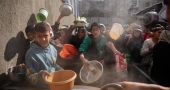
Children trod barefoot on the dirt roads to carry water in plastic jerricans from distribution points to their families living in tent cities teeming with Palestinians driven from their homes. Others wait at charity kitchens with containers to bring back food.
Humanitarian workers say the extended deprivation of education threatens long-term damage to Gaza’s children. Younger children suffer in their cognitive, social and emotional development, and older children are at greater risk of being pulled into work or early marriage, said Tess Ingram, regional spokesperson for UNICEF, the United Nations agency for children.
The longer a child is out of school, the more they are at risk of dropping out permanently and not returning,” she said.
Gaza’s 625,000 school-age children already missed out on almost an entire year of education. Schools shut down after Israel launched its assault on the territory in retaliation for Hamas’ Oct. 7 attack on southern Israel. With languishing negotiations to halt fighting in the Israel-Hamas war, it’s not known when they can return to classes.
More than 90% of Gaza’s school buildings have been damaged by Israeli bombardment, many of them run by UNWRA, the U.N. agency for Palestinians, according to the Global Education Cluster, a grouping of aid organizations led by UNICEF and Save the Children. About 85% are so wrecked they need major reconstruction — meaning it could take years before they are usable again. Gaza’s universities are also in ruins. Israel contends that Hamas militants operate out of schools.
Some 1.9 million of Gaza’s 2.3 million people have been driven from their homes. They have crowded into the sprawling tent camps that lack water or sanitation systems, or U.N. and government schools now serving as shelters.
Kids have little choice but to help familiesMo’men Qudeh said that before the war, his kids enjoyed school. “They were outstanding students. We raised them well,” he said.
Now he, his four sons and his daughter live in a tent in a cemetery in Khan Younis after they had to flee their home in the eastern neighborhoods of the city. The kids get scared sleeping next to the graves of the dead, he said, but they have no alternative.
The continual flow of victims from airstrikes and shelling into the cemetery and the plentiful supply of destroyed buildings are their source for a tiny income.
Every day at 7 a.m., Qudeh and his children start picking through rubble. On a recent day of work, the young kids stumbled off the pile of wreckage with what they found. Qudeh’s 4-year-old son balanced a chunk of concrete under his arm, his blonde curly hair covered in dust. Outside their tent, they crouched on the ground and pounded the concrete into powder.
On a good day, after hours of work, they make about 15 shekels ($4) selling the powder for use in constructing new graves.
Qudeh, who was injured in Israel’s 2014 war with Hamas, said he can’t do the heavy work alone.
“I cry for them when I see them with torn hands,” he said. At night, the exhausted children can’t sleep because of their aches and pain, he said. “They lie on their mattress like dead people,” he said.
Children are eager for a lost educationAid groups have worked to set up educational alternatives — though the results have been limited as they wrestle with the flood of other needs.
UNICEF and other aid agencies are running 175 temporary learning centers, most set up since late May, that have served some 30,000 students, with about 1,200 volunteer teachers, Ingram said. They provide classes in literacy and numeracy as well as mental health and emotional development activities.
But she said they struggle to get supplies like pens, paper and books because they are not considered lifesaving priorities as aid groups struggle to get enough food and medicine into Gaza.
In August, UNRWA began a “back to learning” program in 45 of its schools-turned-shelters that provide children activities like games, drama, arts, music and sports. The aim is to “give them some respite, a chance to reconnect with their friends and to simply be children,” spokesperson Juliette Touma said.
Education has long been a high priority among Palestinians. Before the war, Gaza had a high literacy rate — nearly 98%.
When she last visited Gaza in April, Ingram said children often told her they miss school, their friends and their teachers. While describing how much he wanted to go back to class, one boy abruptly stopped in panic and asked her, “I can go back, can’t I?”
“That was just heartbreaking to me,” she said.
Parents told her they had seen the emotional changes in their children without the daily stability provided by school and with compounding traumas from displacement, bombardment and deaths or injuries in the family. Some become sullen and withdrawn, others become easily agitated or frustrated.
Gaza’s schools are packed with homeless families instead of studentsThe 11-month Israeli campaign has destroyed large swaths of Gaza and brought a humanitarian crisis, with widespread malnutrition and diseases spreading. More than 40,000 Palestinians have been killed, according to Gaza health officials. Children are among the most severely affected. Ingram said nearly all of Gaza’s 1.1 million children are believed to need psychosocial help.
Israel says its campaign aims to eliminate Hamas to ensure it cannot repeat its Oct. 7 attack, in which militants killed some 1,200 people in southern Israel and abducted 250 others.
The conflict has also set back education for Palestinian children in the West Bank, where Israel has intensified movement restrictions and carried out heavy raids.
“On any given day since October, between 8% and 20% of schools in the West Bank have been closed,” Ingram said. When schools are open, attendance is lowered because of difficulties in movement or because children are afraid, she said.
Parents in Gaza say they struggle to give their children even informal teaching with the chaos around them.
At a school in the central town of Deir al-Balah, classrooms were packed with families, their laundry draped over the stairwells outside. Made of bedsheets and tarps propped on sticks, ramshackle tents stretched across the yard.
“The children’s future is lost,” said Umm Ahmed Abu Awja, surrounded by nine of her young grandchildren. “What they studied last year is completely forgotten. If they return to school, they have to start from the beginning.”
1 year ago
Israeli soldiers fatally shot an American woman at a West Bank protest, witnesses say
Israeli soldiers killed an American woman demonstrating against settlements in the West Bank on Friday, according to two witnesses who said she was shot while posing no threat to Israeli forces and during a moment of calm after clashes earlier in the afternoon. Two Palestinian doctors said 26-year-old Aysenur Ezgi Eygi of Seattle was shot in the head.
The United States government confirmed Eygi’s death but did not say whether the recent graduate of the University of Washington, who was also a Turkish citizen, had been shot by Israeli troops. The White House said it was “deeply disturbed” by the killing of a U.S. citizen and called on Israel to investigate what happened.
The Israeli military said it was looking into reports that troops had killed a foreign national while firing at an “instigator of violent activity” in the area of the protest
The killing came amid a surge of violence in the West Bank since the Israel-Hamas war began in October, with increasing Israeli raids, attacks by Palestinian militants on Israelis, attacks by Israeli settlers on Palestinians and heavier military crackdowns on Palestinian protests. More than 690 Palestinians have been killed, according to Palestinian health officials.
On Thursday, Israeli troops shot and killed a 13-year-old Palestinian girl, Bana Laboom, in her village outside the West Bank town of Nabul, Palestinian health officials said. There was no immediate military comment on the report.
Eygi, a volunteer with the activist group International Solidarity Movement, was attending a weekly demonstration against settlement expansion that has been held for years and has often brought Israeli crackdowns and protester stone-throwing.
Jonathan Pollak, an Israeli participating in Friday’s protest, said the shooting occurred shortly after dozens of Palestinians and international activists held a communal prayer on a hillside outside the northern West Bank town of Beita overlooking the Israeli settlement of Evyatar.
Soldiers surrounded the prayer, and clashes soon broke out, with Palestinians throwing stones and troops firing tear gas and live ammunition, Pollak said.
The protesters and activists retreated and clashes subdued, he said. He then watched as two soldiers on the roof of a nearby home trained a gun in the group’s direction and fired.
He said he saw Eygi “lying on the ground, next to an olive tree, bleeding to death.”
Mariam Dag, another ISM activist at the protest, also said she saw an Israeli soldier on a rooftop, then heard the firing of two live bullets. One hit a Palestinian protester in the leg; the other hit Eygi. Dag said she saw blood coming from the fallen woman’s head.
“The shots were coming from the direction of the army,” she said.
Eygi had just arrived in the West Bank on Tuesday, Dag said. She had been “very excited this morning to start. She was really keen on coming to the demonstration.”
“This has been happening to Palestinians for decades. This happened because of the impunity which the Israelis act with,” while Western governments do little, she said.
Two doctors confirmed Eygi was shot in the head — Dr. Ward Basalat, who administered first aid at the scene, and Dr. Fouad Naffa, director of Rafidia Hospital in Nablus where she was taken.
ISM said 17 Palestinians have been killed by Israeli forces at the weekly Beita protests since March 2020. A month ago, an American, Amado Sison, was shot in the leg by Israeli forces, he said, as he tried to flee tear gas and live fire.
At the University of Washington, where Eygi recently graduated with a degree in psychology, Aria Fani, a professor of Middle Eastern languages and cultures, recalled Eygi’s activism earlier in the year at a pro-Palestinian encampment, and remembered her as someone with a gift for listening to others.
Fani said he had tried to talk Eygi out of going to the West Bank but that she told him “she needed to bear witness for the sake of her own humanity.”
Secretary of State Antony Blinken said the U.S. was “intensely focused” on determining what happened and that “we will draw the necessary conclusions and consequences from that.”
In a post on X, the Turkish Foreign Ministry condemned “this murder carried out by” the Israeli government. Turkey will work “to ensure that those who killed our citizen is brought to justice,” ministry spokesperson Oncu Keceli said.
Human rights groups say Israeli soldiers who kill Palestinians — or their foreign supporters — rarely are held to account. The Israeli military says it investigates such instances and takes action if there is criminal wrongdoing.
At least three activists from the International Solidarity Movement have been killed since 2000.
Two of them were killed in Gaza in 2003. American Rachel Corrie was crushed to death as she tried to block an Israeli military bulldozer from demolishing a Palestinian home. About a month later, British citizen Tom Hurndall was shot in the head by an Israeli soldier. ISM activists often place themselves between Israeli forces and Palestinians to try to stop the Israeli military from carrying out operations.
The Israeli military ruled Corrie’s death an accident, a conclusion widely rejected by rights groups. The soldier who killed Hurndall was sentenced to 11 1/2 years in prison and was released after serving just over half of it.
Shireen Abu Akleh — a Palestinian-American journalist with the Al Jazeera news network — was shot to death covering an Israeli raid in the West Bank in 2022. The United States concluded an Israeli soldier likely killed her by mistake, and Israel acknowledged that was a “high probability” but not certain and ruled out a criminal investigation. Al Jazeera accuses troops of intentionally killing her.
A handful of Americans have been killed in the West Bank since the Israel-Hamas war began, apparently by Israeli fire. Two Palestinian American teens, Mohammad Khdour and Tawfic Abdel Jabbar, were shot to death in the span of a month while driving close to their villages. The findings of U.S. and Israeli investigations into their deaths have not been released.
In a statement Thursday, U.S. Senator Chris Van Hollen of Maryland said President Joe Biden’s administration has not done enough “to pursue justice and accountability” for Khdour and Abdel Jabbar. He said it must “use American influence to demand the prosecution of those responsible for harm against American citizens.”
1 year ago
Gaza enters 2nd school year without schooling
This week, when they would normally be going back to school, the Qudeh family’s children stumbled with armfuls of rubble they collected from a destroyed building to sell for use in building graves in the cemetery that is now their home in southern Gaza.
“Anyone our age in other countries is studying and learning,” said 14-year-old Ezz el-Din Qudeh, after he and his three siblings — the youngest a 4-year-old — hauled a load of concrete chunks. “We’re not. We’re working at something beyond our capacities. We are forced to in order to get a living.”
As Gaza enters its second school year without schooling, most of its children are caught up helping their families in the daily struggle to survive amid Israel’s devastating campaign.
Children trod barefoot on the dirt roads to carry water in plastic jerricans from distribution points to their families living in tent cities teeming with Palestinians driven from their homes. Others wait at charity kitchens with containers to bring back food.
Humanitarian workers say the extended deprivation of education threatens long-term damage to Gaza’s children. Younger children suffer in their cognitive, social and emotional development, and older children are at greater risk of being pulled into work or early marriage, said Tess Ingram, regional spokesperson for UNICEF, the United Nations agency for children.
“The longer a child is out of school, the more they are at risk of dropping out permanently and not returning,” she said.
Gaza’s 625,000 school-age children already missed out on almost an entire year of education. Schools shut down after Israel launched its assault on the territory in retaliation for Hamas’ Oct. 7 attack on southern Israel. With languishing negotiations to halt fighting in the Israel-Hamas war, it’s not known when they can return to classes.
More than 90% of Gaza's school buildings have been damaged by Israeli bombardment, many of them run by UNWRA, the U.N. agency for Palestinians, according to the Global Education Cluster, a grouping of aid organizations led by UNICEF and Save the Children. About 85% are so wrecked they need major reconstruction — meaning it could take years before they are usable again. Gaza’s universities are also in ruins. Israel contends that Hamas militants operate out of schools.
Some 1.9 million of Gaza’s 2.3 million people have been driven from their homes. They have crowded into the sprawling tent camps that lack water or sanitation systems, or U.N. and government schools now serving as shelters.
Kids have little choice but to help familiesMo’men Qudeh said that before the war, his kids enjoyed school. “They were outstanding students. We raised them well,” he said.
Now he, his four sons and his daughter live in a tent in a cemetery in Khan Younis after they had to flee their home in the eastern neighborhoods of the city. The kids get scared sleeping next to the graves of the dead, he said, but they have no alternative.
The continual flow of victims from airstrikes and shelling into the cemetery and the plentiful supply of destroyed buildings are their source for a tiny income.
Every day at 7 a.m., Qudeh and his children start picking through rubble. On a recent day of work, the young kids stumbled off the pile of wreckage with what they found. Qudeh’s 4-year-old son balanced a chunk of concrete under his arm, his blonde curly hair covered in dust. Outside their tent, they crouched on the ground and pounded the concrete into powder.
On a good day, after hours of work, they make about 15 shekels ($4) selling the powder for use in constructing new graves.
Qudeh, who was injured in Israel’s 2014 war with Hamas, said he can’t do the heavy work alone.
“I cry for them when I see them with torn hands,” he said. At night, the exhausted children can’t sleep because of their aches and pain, he said. “They lie on their mattress like dead people,” he said.
Children are eager for a lost educationAid groups have worked to set up educational alternatives — though the results have been limited as they wrestle with the flood of other needs.
UNICEF and other aid agencies are running 175 temporary learning centers, most set up since late May, that have served some 30,000 students, with about 1,200 volunteer teachers, Ingram said. They provide classes in literacy and numeracy as well as mental health and emotional development activities.
But she said they struggle to get supplies like pens, paper and books because they are not considered lifesaving priorities as aid groups struggle to get enough food and medicine into Gaza.
In August, UNRWA began a “back to learning” program in 45 of its schools-turned-shelters that provide children activities like games, drama, arts, music and sports. The aim is to “give them some respite, a chance to reconnect with their friends and to simply be children,” spokesperson Juliette Touma said.
Education has long been a high priority among Palestinians. Before the war, Gaza had a high literacy rate — nearly 98%.
When she last visited Gaza in April, Ingram said children often told her they miss school, their friends and their teachers. While describing how much he wanted to go back to class, one boy abruptly stopped in panic and asked her, “I can go back, can’t I?”
“That was just heartbreaking to me,” she said.
Parents told her they had seen the emotional changes in their children without the daily stability provided by school and with compounding traumas from displacement, bombardment and deaths or injuries in the family. Some become sullen and withdrawn, others become easily agitated or frustrated.
Gaza's schools are packed with homeless families instead of students
The 11-month Israeli campaign has destroyed large swaths of Gaza and brought a humanitarian crisis, with widespread malnutrition and diseases spreading. More than 40,000 Palestinians have been killed, according to Gaza health officials. Children are among the most severely affected. Ingram said nearly all of Gaza’s 1.1 million children are believed to need psychosocial help.
Israel says its campaign aims to eliminate Hamas to ensure it cannot repeat its Oct. 7 attack, in which militants killed some 1,200 people in southern Israel and abducted 250 others.
The conflict has also set back education for Palestinian children in the West Bank, where Israel has intensified movement restrictions and carried out heavy raids.
“On any given day since October, between 8% and 20% of schools in the West Bank have been closed,” Ingram said. When schools are open, attendance is lowered because of difficulties in movement or because children are afraid, she said.
Parents in Gaza say they struggle to give their children even informal teaching with the chaos around them.
At a school in the central town of Deir al-Balah, classrooms were packed with families, their laundry draped over the stairwells outside. Made of bedsheets and tarps propped on sticks, ramshackle tents stretched across the yard.
“The children’s future is lost,” said Umm Ahmed Abu Awja, surrounded by nine of her young grandchildren. “What they studied last year is completely forgotten. If they return to school, they have to start from the beginning.”
1 year ago
Israeli forces appear to withdraw from a West Bank camp after a major military operation
Israeli forces appeared Friday to have withdrawn from the Jenin refugee camp in the occupied West Bank, after a more-than weeklong military operation that has left dozens dead and a trail of destruction.
Overnight, Israeli armored personnel carriers were seen leaving the camp from a checkpoint set up on one of the main roads, and an Associated Press reporter inside the camp saw no evidence of any remaining troops inside as dawn broke early Friday morning.
Israel's military had no immediate comment but said it would issue a statement later in the day. It was not clear whether the apparent withdrawal was only a temporary measure to regroup forces.
Hundreds of Israeli troops have been involved for more than a week in what has been their deadliest operation in the occupied West Bank since the Israel-Hamas war began, employing what the United Nations called “lethal war-like tactics.”
Their focus has been the Jenin refugee camp, a stronghold of Palestinian militancy that has grown since the Hamas attack on Israel that started the war in Gaza nearly 11 months ago.
Fighting in Jenin accounts for 21 of 39 Palestinians who local health officials say have been killed during the Israeli push in the West Bank — most of whom, the military says, have been militants.
The fighting has had a devastating effect on Palestinian civilians living in Jenin.
Water and electric services have been cut, families have been confined to their homes and ambulances evacuating the wounded have been slowed on their way to nearby hospitals, as Israeli soldiers search for militants.
In the quiet morning Friday, Jenin residents took advantage of the lull to rummage through the rubble of destroyed buildings and take stock of the damage.
Twisted rebar protruded from the concrete of collapsed buildings, and walls still standing were pockmarked by bullets and shrapnel.
During the operation, Israeli military officials said they were targeting militants in Jenin, Tulkarem and the Al-Faraa refugee camp curb recent attacks against Israeli civilians they say have become more sophisticated and deadly.
It was not immediately clear whether they were removing troops from the other two camps as well.
The war in Gaza began when Hamas and other militants staged a surprise attack on Israel on Oct. 7, killing around 1,200 people, primarily civilians. Hamas is believed to still be holding more than 100 hostages. Israeli authorities estimate about a third are dead.
Israel’s retaliatory offensive has killed more than 40,000 Palestinians, according to the Health Ministry in Hamas-controlled Gaza, which doesn’t distinguish between civilians and combatants in its count. The ministry reports that more than 94,000 more have been wounded since the start of the war.
Israel has been under increasing pressure from the United States and other allies to reach a cease-fire deal in Gaza, but Prime Minister Benjamin Netanyahu insists on a demand that has emerged as a major sticking point in talks — continued Israeli control of the Philadelphi corridor, a narrow band along Gaza’s border with Egypt where Israel contends Hamas smuggles weapons into Gaza. Egypt and Hamas deny it.
Hamas has accused Israel of dragging out months of negotiations by issuing new demands, including for lasting Israeli control over both Philadelphi corridor and a second corridor running across Gaza.
Hamas has offered to release all hostages in return for an end to the war, the complete withdrawal of Israeli forces and the release of a large number of Palestinian prisoners, including high-profile militants — broadly the terms called for under an outline for a deal put forward by U.S. President Joe Biden in July.
1 year ago
Netanyahu gives a starkly different take on Biden administration's hopes for a Gaza deal
The Biden administration and Israeli Prime Minister Benjamin Netanyahu were sharply at odds Thursday over prospects of reaching a deal for a Gaza cease-fire and hostage release, with Netanyahu saying it was “exactly inaccurate” that a breakthrough was close.
“There's not a deal in the making,” Netanyahu said in an interview with “Fox and Friends." His public skepticism comes as U.S. officials said they were working on a revised proposal to address remaining disputes between Israeli and Hamas leaders after the weekend discovery of six dead hostages added urgency to the talks.
National security spokesman John Kirby reiterated Thursday that only disagreements on “implementing details” of a cease-fire proposal need to be hammered out.
“I’ve heard what the prime minister said. I’m not going to get into a back and forth with him in a public setting," Kirby told reporters. “We still believe, though this is incredibly difficult ... if there’s compromise, if there’s leadership, we can still get there.”
President Joe Biden's team, a lame-duck administration two months before the election, has projected optimism this summer as it works with fellow mediators Egypt and Qatar to try to get Israel and Hamas to agree to a truce in the 11-month war in Gaza. The deal would release more of the hostages taken by Hamas during its Oct. 7 attack on Israel, including Americans, in exchange for Palestinian prisoners — one of the big sticking points.
U.S. officials said in the days before Israeli forces recovered the bodies of six recently slain hostages, including Israeli-American Hersh Goldberg-Polin, that Israeli and Hamas leaders could sign off on a deal as soon as the end of this week.
“I’m optimistic. It’s far from over. Just a couple more issues. I think we’ve got a shot,” Biden told reporters last Friday.
Even before that, Netanyahu was digging in his heels, adding conditions that make sealing any agreement before the U.S. elections difficult. His far-right government publicly prioritized for the first time in July — months into the talks — a demand for Israeli forces to keep their presence in a buffer zone along Gaza’s border with Egypt. Netanyahu says it's needed to prevent Hamas from smuggling arms into the Palestinian territory.
“To ask Israel to make concessions after this murder is to send a message to Hamas: Murder more hostages, you’ll get more concessions,” Netanyahu said Thursday. "That’s the wrong thing to do, and I think the Israel public overwhelming is united against that.”
Hostage families have accused Netanyahu of blocking a deal and potentially sacrificing their loved ones to hold the border strip, called the Philadelphi corridor. Hundreds of thousands of Israelis have taken to the streets, calling for a deal and saying time is running out to bring home the hostages alive.
Netanyahu has brushed off criticism that his management of the war and cease-fire negotiations has been politically motivated and said he believes only heavy pressure on Hamas will force it into concessions.
The Biden administration has stressed that its ally Israel has supported the negotiations and Hamas has been blocking a deal. This week, however, Biden said “no” when asked if Netanyahu was doing enough in the talks.
“We see time and again that Israel agrees to certain terms,” said Shira Efron, a policy adviser at the U.S.-based Israel Policy Forum, which analyzes Israeli-Palestinian relations. “It doesn't say no, it agrees to certain terms — but then says, ‘Yes, but under those conditions.’”
"These public statements that come out after what seems to be an agreement ... basically derail the agreement," Efron said.
Randa Slim, a senior fellow at the U.S.-based Middle East Institute research center, said she saw the talks as being between the U.S. and Netanyahu, and “in this bilateral negotiation, I see Netanyahu having the upper hand.”
The U.S., Egypt and other Arab nations have raised objections to a lasting Israeli presence in the Philadelphi corridor. Hamas says the Israeli position is in breach of the bridging proposal’s call for Israel to leave densely populated areas of Gaza.
U.S. officials say Israeli officials, including Netanyahu, have been more agreeable to negotiations in private discussions than in their public statements.
A senior U.S. administration official told reporters Wednesday that Israel and Hamas have agreed on 14 of the 18 paragraphs in the bridging proposal, have technical differences about one paragraph and deeper differences about three paragraphs. The official spoke on condition of anonymity to discuss the negotiations.
Those three paragraphs in question focus on the exchange of hostages captured by Hamas and the number of Palestinian prisoners who would be released during what is supposed to be at least a six-week cease-fire.
The list of Palestinian prisoners to be released in the initial phase of the deal includes some who are serving life sentences in Israeli prisons. The official said the dispute about the ratio of prisoners to hostages to be swapped has been further complicated by the recent deaths of the six hostages.
For each hostage, there’s a certain number of Palestinian prisoners that were to be released. Now, “you just have fewer hostages as part of the deal in phase one,” the official said.
Netanyahu said they are still discussing the number of prisoners to be released for each hostage, the list of prisoners to be freed and whether they will be allowed to return home or have to leave.
The U.S. and others hope a cease-fire would calm tensions that threaten a wider regional conflict, including fighting between Israel and Hezbollah militants in neighboring Lebanon.
Attacks by Hezbollah and other Iran-backed groups have increased since the Oct. 7 attack, in which some 1,200 people were killed. Militants also took about 250 people hostage, with roughly 100 remaining in Gaza, a third of whom are believed to be dead.
Israel's offensive in response has killed more than 40,000 Palestinians, according to Gaza’s Health Ministry, which does not distinguish between civilians and combatants in its count.
When it comes to a deal, “we’re being pragmatic about it, and we do believe that we have made an immense amount of progress in the last few months in terms of getting the structure of the deal in place,” Kirby said.
1 year ago
Israel's Netanyahu demands open-ended control of Gaza's border with Egypt
Israeli Prime Minister Benjamin Netanyahu said Wednesday that Israel must keep open-ended control of Gaza’s border with Egypt, digging in on his stance on an issue that has threatened to derail cease-fire efforts.
Netanyahu’s comments came as the United States is developing a new proposal for a cease-fire and hostage release, hoping to break a long deadlock and bring an end to the nearly 11-month-old war.
The question of Israeli control of the Philadelphi corridor –- a narrow strip of land along Gaza’s border with Egypt, seized by troops in May –- has become a central obstacle in the talks. Hamas has demanded an eventual full Israeli withdrawal from Gaza in the multi-phase truce deal.
Egypt, a mediator in the talks along with the U.S. and Qatar, has also demanded a concrete timeline for Israeli troops to leave the Philadelphi corridor. And on Wednesday, the United Arab Emirates, which established formal ties with Israel in the 2020 Abraham Accords, also criticized the Israeli stance.
Speaking to foreign journalists, Netanyahu repeated his stance that Israel must maintain its hold on the border to prevent Hamas from rearming by smuggling weapons into Gaza. He said it was a vital part of the war goal of ensuring Hamas cannot repeat its Oct. 7 attack on Israel.
“Gaza must be demilitarized, and this can only happen if the Philadelphi corridor remains under firm control,” he said, claiming Israeli troops had discovered dozens of tunnels under the border.
He said Israel would only consider withdrawing from the corridor when presented with an alternative force to police it.
“Bring me anyone who will actually show us … that they can actually prevent the recurrence” of smuggling, he said. “I don’t see that happening right now. And until that happens, we’re there.”
Families of remaining hostages have stepped up their demands that he agree to a deal after Hamas killed six hostages last week as Israeli troops appeared to be moving to rescue them. In angry public statements, hostage families have accused Netanyahu of blocking a deal and potentially sacrificing their loved ones’ lives for the sake of holding the border strip. Hundreds of thousands of Israelis have taken to the streets in recent days, calling for a deal and saying time is running out to bring home the hostages alive.
Netanyahu pushed back against the pressure, saying his stance was necessary to “ensure Hamas doesn’t pose a threat to Israel.”
“I can understand the torment of families,” he said. “But the responsibility of leaders is not merely to share the sentiment, the emotion, but also to exercise judgment.”
Asked by journalists for a timeline on ending the war, he refused to give one. “How long can we do this? As long as it takes to achieve this victory. And I think we’re getting a lot closer,” he said.
Netanyahu repeatedly insisted holding the border would also pressure Hamas to release hostages. At one point, he erroneously claimed the invasion of Rafah in May forced Hamas’ first release of hostages – which took place months earlier in November under a weeklong ceasefire deal. He then said the deal was “the result of our invasion, the military pressure we put on them.”
The Palestinian news agency WAFA reported early Thursday that an Israeli drone strike killed five men and wounded another in a car in Tubas in the West Bank.
The Israeli military said in a statement that it carried out “three targeted strikes on armed terrorists that posed a threat on the soldiers,” without immediately elaborating. For more than a week, hundreds of Israeli forces have been carrying out the deadliest operation in the occupied West Bank since the Israel-Hamas war began.
1 year ago
US charges Hamas leader, other militants in connection with Oct. 7 massacre in Israel
The Justice Department announced criminal charges Tuesday against Hamas leader Yahya Sinwar and other senior militants in connection with the Oct. 7, 2023, rampage in Israel, marking the first effort by American law enforcement to formally call out the masterminds of the attack.
The seven-count criminal complaint filed in federal court in New York City includes charges such as conspiracy to provide material support to a foreign terrorist organization resulting in death, conspiracy to murder U.S. nationals and conspiracy to finance terrorism. It also accuses Iran and Lebanon's Hezbollah of providing financial support, weapons, including rockets, and military supplies to Hamas for use in attacks.
The impact of the case may be mostly symbolic given that Sinwar is believed to be hiding in tunnels in Gaza and the Justice Department says three of the six defendants are believed now to be dead. But officials say additional actions are expected as part of a broader effort to target a militant group that the U.S. designated as a foreign terrorist organization in 1997 and that over the decades has been linked to a series of deadly attacks on Israel, including suicide bombings.
The complaint was originally filed under seal in February to give the U.S. time to try to take into custody then-Hamas leader Ismail Haniyeh and other defendants, but it was unsealed Tuesday after Haniyeh's death in July and other developments in the region lessened the need for secrecy, the Justice Department said.
"The charges unsealed today are just one part of our effort to target every aspect of Hamas’ operations,” Attorney General Merrick Garland said in a video statement. “These actions will not be our last.”
The charges come as the White House says it is developing a new cease-fire and hostage deal proposal with its Egyptian and Qatari counterparts to try to bring about an agreement between Israel and Hamas to end the nearly 11-month war in Gaza.
A U.S. official, who was not authorized to talk publicly about the case and spoke on condition of anonymity, told The Associated Press there was no reason to believe the charges would affect the ongoing negotiations.
National security spokesman John Kirby said the recent “executions” of six hostages, including one American, Hersh Goldberg-Polin, by Hamas underscore "the sense of urgency” in the talks.
“We are investigating Hersh’s murder, and each and every one of the brutal murders of Americans, as acts of terrorism,” Garland said in the statement. “We will continue to support the whole of government effort to bring the Americans still being held hostage home.”
Sinwar was appointed the overall head of Hamas after the killing of Haniyeh in Iran and sits atop Israel’s most-wanted list. He is believed to have spent most of the past 10 months living in tunnels under Gaza, and it is unclear how much contact he has with the outside world. He was a long-serving Palestinian prisoner freed in an exchange of the type that would be part of a cease-fire and hostage release deal.
Haniyeh was also charged.
Other Hamas leaders facing charges include Marwan Issa, deputy leader of Hamas’ armed wing in Gaza, who helped plan last year's attack and who Israel says was killed when its fighter jets struck an underground compound in central Gaza in March; Khaled Mashaal, another Haniyeh deputy and a former leader of the group thought to be based in Qatar; Mohammed Deif, Hamas’ longtime shadowy military leader who was thought to be killed in an Israeli airstrike in southern Gaza in July; and Lebanon-based Ali Baraka, Hamas’ head of external relations.
The charges are “yet another tool” for the U.S. to respond to the threat Hamas poses to the U.S. and its ally Israel, said Merissa Khurma, Middle East program director at the Wilson Center think tank in Washington.
“If Sinwar is found and brought to justice for planning the October 7 attacks, it would be a significant win for the U.S. and for all those who lost loved ones,” she said by email.
However, with Sinwar in hiding, Khurma doesn’t see the charges adding more pressure on Hamas. She noted that the chief prosecutor of the world’s top war crimes court sought arrest warrants for Hamas leaders like Sinwar and it didn’t change their behavior or weaken them in the cease-fire negotiations.
She said the case was still important for the U.S. because many of those killed or kidnapped were Americans and because the country doesn’t recognize the International Criminal Court.
During the Oct. 7 attacks, militants killed some 1,200 people, mostly civilians, and took about 250 people hostage. Roughly 100 hostages remain, a third of whom are believed to be dead.
The criminal complaint describes the massacre as the “most violent, large-scale terrorist attack” in Hamas' history. It details how Hamas operatives who arrived in southern Israel with “trucks, motorcycles, bulldozers, speedboats, and paragliders” engaged in a brutal campaign of violence that included rape, genital mutilation and machine-gun shootings at close range.
Israel’s retaliatory offensive has killed over 40,000 Palestinians, according to Gaza’s Health Ministry, which does not distinguish between civilians and combatants in its count. The war has caused widespread destruction, forced the vast majority of Gaza’s 2.3 million residents to flee their homes, often multiple times, and created a humanitarian catastrophe.
Hamas has accused Israel of dragging out months of negotiations by issuing new demands, including for lasting Israeli control over the Philadelphi corridor along the border of Egypt and a second corridor running across Gaza.
Hamas has offered to release all hostages in return for an end to the war, the complete withdrawal of Israeli forces and the release of a large number of Palestinian prisoners, including high-profile militants — broadly the terms called for under an outline for a deal put forward by President Joe Biden in July.
Israeli Prime Minister Benjamin Netanyahu has pledged “total victory” over Hamas and blames it for the failure of the negotiations.
1 year ago