Others
Dismembered body in Mugda: RAB arrests two over brutal killing
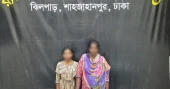
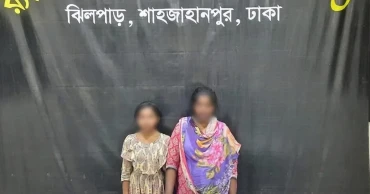
Members of Rapid Action Battalion (RAB)-3 have arrested a woman and her daughter in connection with the sensational killing and dismemberment of a Saudi expatriate from Brahmanbaria, whose body was cut into eight pieces and dumped in polythene bags in different areas of Manda in the capital.
The arrested are Helena Begum, 40, daughter of Siddiq Mia, and her middle daughter Halima Akter, 13, daughter of late Sheikh Mohammad Chobed, both residents of Nandarampur under Narsingdi Sadar upazila.
Kaarina Kaisar’s body to arrive in Dhaka this afternoon; burial on Monday
They were arrested with evidence around 11:45pm on May 17.
According to RAB, the victim, Mokarram Mia, 37, a Saudi expatriate from Brahmanbaria, had a good relationship with another expatriate from the same village, Sumon. Through him, Mokarram became acquainted with Sumon’s wife Taslima Akter Hasna, 31, while both men were in Saudi Arabia.
At one stage, Mokarram and Taslima developed a romantic relationship and regularly communicated via audio and video calls on social media. According to Helena, Mokarram had given Taslima more than Tk 500,000 at different times while staying abroad.
On May 13, Mokarram returned to Bangladesh from Saudi Arabia without informing his family and travelled from Hazrat Shahjalal International Airport to Kamalapur by train before going to meet Taslima at the rented house of her friend Helena in Manda under Mugda Police Station. Helena lived in the one-room house with her two daughters, where Mokarram, Taslima and the others stayed together.
RAB said a dispute arose between Mokarram and Taslima over their relationship. On the night of May 13, Helena allegedly caught Mokarram attempting inappropriate conduct with her minor daughter Halima. Later that night, a quarrel broke out between Mokarram and Taslima over marriage.
When Mokarram insisted on marrying her, Taslima refused. Mokarram then demanded the return of over Tk 500,000 he had given her and Taslima threatened him.
Following the dispute, Taslima and Helena allegedly planned to kill Mokarram. Helena agreed out of anger over the alleged misconduct involving her daughter.
According to the plan, on the morning of May 14, they mixed sleeping pills in water and gave it to Mokarram.
Taking advantage of the situation, Taslima attempted to strike him with a hammer, but Mokarram snatched it and tried to attack her.
Later, Helena struck Mokarram on the neck with a sharp ‘boti’, causing him to fall. Halima then hit him on the head with a hammer. Then make his body 8 parts and threw away them in dust bin in the ground floor but the head threw far from 1km from the house.
However, on the afternoon of May 17, a foul smell from the decomposing body parts drew the attention of locals, who informed police by calling 999. Police recovered the body parts and sent them to Dhaka Medical College Hospital for autopsy after completing legal procedures.
The victim was later identified as Mokarram through fingerprint analysis using his national ID.
RAB said it launched intelligence operations after learning about the incident and arrested the prime accused Helena and her daughter Halima. Based on Helena’s information, the victim’s head was recovered from an area about one kilometre away.
Efforts are underway to arrest another accused, Taslima Akter.
Legal proceedings against the arrested are under process.
18 days ago
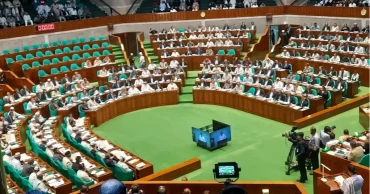
Govt considering black money whitening facility in upcoming budget
The government is considering a special tax amnesty in the upcoming national budget for the upcoming fiscal year FY2026-27, allowing individuals to whiten undisclosed money and assets held both at home (Domestic) and abroad, according to the sources of Ministry of Finance.
The initiative aims to break the ongoing stagnation in private sector investment and channel idle capital into the mainstream economy, officials said.
The national budget for FY 2026-27 is scheduled to be presented in Parliament on June 11.
Ahead of the budget, during pre-budget discussions in April, the Real Estate and Housing Association of Bangladesh (REHAB) urged the government to allow flat purchases without any questions regarding the source of income. REHAB demanded the reinstatement of the former provision (Section 19BBBBB) of the Income Tax Ordinance to boost investment in the housing sector.
The opportunity to whiten untaxed income has a long history in Bangladesh, first introduced under martial law in 1975. Since then, successive governments have periodically extended this facility.
During the military-backed caretaker government in FY 2007-08 and FY 2008-09, a record Tk 9,683 crore was legalized. This record was later shattered in FY 2020-21, when an unprecedented Tk 20,500 crore was whitened by 11,839 individuals under a 10 percent tax rate, yielding Tk 2,064 crore in revenue for the NBR.
Subsequent budgets also offered similar amnesties. In FY 2021-22 and FY 2023-24, a 7.5 percent tax rate was offered to repatriate undisclosed offshore assets. In FY 2024-25, a blanket opportunity was given to legalize undisclosed cash, stocks, and investments with a 15 percent tax, offering total immunity from any legal scrutiny.
While the interim government initially introduced measures to allow investment of undisclosed money in apartments and buildings in the last proposed budget, it faced severe backlash from economists and civil society. Consequently, the government modified the approach by continuing the facility but raising the tax rates based on the location and size of the property.
Under that structure, area-specific taxes for flat purchases ranged from Tk 100 to Tk 2,000 per square foot across capital Dhaka, Chattogram, other divisional cities, and municipalities. For building constructions, the tax ranged from Tk 50 to Tk 900 per square foot.
NBR officials indicated that the upcoming policy may likely follow a structured path, offering specific investment windows to legally incorporate domestic and foreign undisclosed assets back into the formal financial framework.
However, economists warn that such recurring amnesties create moral hazards. Speaking to reporters, several prominent economists noted that these provisions impose moral pressure on honest taxpayers, often making them feel helpless.
They, however, acknowledged that procedural complexities sometimes unintentionally generate undisclosed money, particularly through remittance channels or the sale of fixed assets.
18 days ago
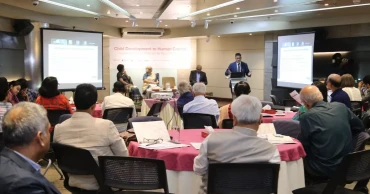
Early childhood investment can break poverty cycle, experts tell Dhaka workshop
Bangladesh must place children at the heart of its national poverty strategy if it hopes to build a skilled, mobile workforce capable of navigating the challenges of the 21st century, experts and senior government officials said at a high-level policy workshop at BRAC Center, Mohakhali, on Sunday.
"Investments prioritising our children are a forward-looking investment in our collective future. That is an investment worth making," said Dr Mohammad Abu Yusuf, Secretary of the Ministry of Social Welfare, during the closing session of the event jointly organised by BRAC Institute of Governance and Development (BIGD) and Oxford Policy Management (OPM).
The workshop brought together government officials, development agency representatives, academics and civil society leaders to examine the causal links between early childhood development (ECD), education, poverty and social mobility, and to identify social protection strategies to address these challenges.
Delivering the keynote perspective, Dr Jena Hamadani, Emeritus Scientist at icddr,b, made the economic case for early investment.
"Supporting early childhood development promotes a skilled workforce that can take advantage of opportunities and contribute to a productive and healthy economy," she said, adding that ECD "provides an incredible return on investment when compared with later interventions."
Participants heard research from BIGD on social mobility and from OPM's Thrive and DEEP programmes on early childhood development and poverty.
Professor Andy McKay of the University of Sussex, joining online, explored how inter-generational an intra-generational mobility connect to poverty dynamics, building on work presented at the DEEP International Conference in Arusha in 2025.
On the financing side, Dr Abdur Razzaque, Chairman of RAPID, argued that adequate resourcing is within reach.
He said that if implemented properly, a three percent commitment of Bangladesh's GDP "can accommodate both the Family Card and wider lifecycle-based expansion" of social protection.
A note of alarm was sounded by Dr Hossain Zillur Rahman, Executive Chairman of PPRC, who said education, historically a driver of equality, was now widening the gap.
"Historically, education had been a driver of equality, but now education is driving inequality," he said, pointing to growing aspirational deficits among populations facing prolonged unemployment as a troubling sign of stalled mobility.
On delivery challenges, Dr Imran Matin, Executive Director of BIGD, warned against treating integration in isolation.
He argued that fragmentation in Bangladesh's social safety net could not be resolved without simultaneously addressing decentralisation challenges and strengthening local government. "We really need to do more implementation research and put the people back at the centre."
The role of data in shaping effective policy was also highlighted. Dr Dipankar Roy, Joint Secretary and Project Director at the Statistics and Informatics Division of the Ministry of Planning, called for closer collaboration between researchers and the Bangladesh Bureau of Statistics (BBS) and greater public access to data, describing it as a public good.
The event also featured sessions on integrating parenting support with cash transfers and a case study on the intergenerational impacts of productive safety nets, including Thrive's Saving Bangladeshi Babies' Brains programme, which is delivering ECD interventions at scale through the Government of Bangladesh.
18 days ago

NEC meeting on Monday likely to consider Tk 3 lakh crore proposed ADP
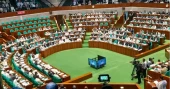
The National Economic Council (NEC) is likely to consider a proposed Annual Development Programme (ADP) worth Tk 3,00,000 crore for the 2026-27 fiscal year on Monday.
Prime Minister Tarique Rahman is scheduled to preside over the meeting.
According to officials at the Bangladesh Planning Commission, the proposed ADP includes Tk 1,90,000 crore from government funds and Tk 1,10,000 crore from foreign loans and grants.
The proposed ADP size marks a 50 percent increase from the revised ADP of the current fiscal year, with domestic resource allocation rising by 48.44 percent and external financing increasing by 52.77 percent.
The programme prioritises poverty reduction, employment generation, women’s empowerment, balanced regional development, tourism, blue economy, green growth and improvement of living standards.
If self-financed projects of autonomous bodies and corporations are included, the total proposed outlay would stand at Tk 3,08,924.83 crore, officials said.
The proposed ADP includes 971 investment and survey projects with an allocation of Tk 1,78,914.63 crore and 107 technical assistance projects involving Tk 2,796.28 crore.
Besides, Tk 38,027.49 crore has been proposed as “special development assistance” block allocation for newly approved and ongoing projects, while another Tk 17,000 crore has been earmarked for social development assistance.
According to the proposed ADP working paper, the transport and communication sector is set to receive the highest allocation of Tk 50,092.53 crore, accounting for 16.70 percent of the total ADP.
The education sector is likely to receive Tk 47,591.12 crore, while the health sector may get Tk 35,535.50 crore.
The power and energy sector is proposed to receive Tk 32,691.54 crore, while the housing and community facilities sector would get Tk 20,361.72 crore.
Among ministries and divisions, the Local Government Division is likely to receive the highest allocation of Tk 33,735.10 crore, followed by the Roads and Highways Division with Tk 30,741.36 crore.
According to the Implementation Monitoring and Evaluation Division (IMED), ADP implementation during July 2025-March 2026 stood at 36.19 percent, with expenditure amounting to Tk 75,607 crore against the revised allocation of Tk 2,08,936 crore.
The new ADP will include 1,121 development projects, down from 1,333 projects under the current revised ADP.
18 days ago
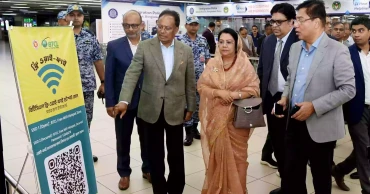
Free Wi-Fi service launched at Shahjalal Int’l Airport
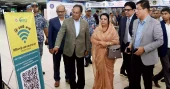
Free Wi-Fi service was launched at Hazrat Shahjalal International Airport on Sunday in bid to ensure digital services for the passengers in the country’s busiest airport.
More than 37,000 passengers would use the free Wi-Fi services simultaneously in the airport.
Civil Aviation and Tourism Afroza Khanam inaugurated the free Wi-Fi service, while Posts, Telecommunications and Information Technology Minister Faqir Mahbub Anam, state minister for civil aviation and tourism M Rashiduzzaman Millat and PM’s adviser on Telecommunication and Information Technology Rehan Asif Asad were present.
Addressing a press briefing, the Civil Aviation Minister said the current democratic government is providing high-quality digital services to the airport passengers in line with the electoral pledge of 'fast and reliable internet for all' announced in the election manifesto.
About the third terminal of the Airport, she expressed optimism that the new terminal could be inaugurated soon. “Hopefully, we will be able to inaugurate the third terminal soon and that will be an important milestone for us,” she added.
The Wi-Fi network covers nearly 94,000 square metres of the airport, including Terminal 1, Terminal 2, the Domestic Terminal, VIP Terminal, VVIP Terminal and car parking areas, enabling passengers to access free internet services across almost all key parts of the airport, said a PID handout.
The service has been built on modern network infrastructure, including 250 access points (APs), 48 kilometres of optical fibre and Ethernet cable installations, and 37 access switches to ensure stable and high-speed connectivity.
18 days ago
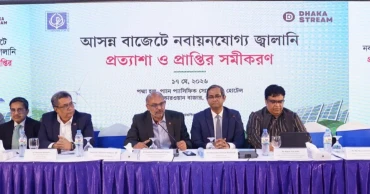
Govt sets 5 energy security milestones to break import dependence: Titumir
The government has begun work on achieving five key milestones to secure Bangladesh's energy future, with a strong push toward renewable energy and reducing dependence on imports, said Prime Minister's Adviser on Finance and Planning Rashed Al Mahmud Titumir on Sunday.
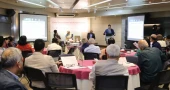
Speaking at a dialogue titled "Renewable Energy in the Upcoming Budget: Expectations and Reality" organised by think tank Centre for Policy Dialogue (CPD) at a city hotel, Titumir said the country's energy sector had long been surrendered to oligarchs under import-dependent policies that left Bangladesh economically vulnerable.
"The entire energy sector was handed over to oligarchs and made import-reliant. Instead of driving industrialisation, energy policies pursued in the past made Bangladesh economically dependent on others," he said.
The adviser outlined five priority milestones guiding the government's energy roadmap:
First, the upcoming budget will allocate greater resources toward renewable energy which he described as the sector's top priority.
Second, energy pricing will be aligned with consumers' income levels.
"There are two categories of consumers: general consumers and industrialists who are investors. Among general consumers, there are three tiers: upper, middle and lower income groups. Prices will be set in accordance with each group's income, with due regard for the decisions of the regulatory commission." the adviser said.
Third, a new policy framework will be developed to encourage the uptake of renewable energy, with a view to moving from import dependence toward self-sufficiency.
Fourth, domestic gas exploration will resume. "Bangladesh will restart gas field exploration. Only relying on foreign agencies will not be allowed. Steps have already been taken to strengthen state-owned BAPEX to build domestic capacity," the adviser said.
Fifth, minimum fuel reserves will be maintained across all energy sources. "There was never any concept of strategic reserves in this sector. The government is now paying serious attention to that," Titumir said.
Titumir criticised the existing structure of the power sector, saying a large gap between installed capacity and actual utilisation was draining public resources. "Excessive capacity was retained knowing it would never be used, turning capacity charges into a serious burden."
He also questioned the legal basis of several power sector contracts, saying they were not in line with the country's energy security interests. "The structural upgrades needed to transition away from fossil fuels toward a liveable, environmentally safe framework were never made, which is a grave failing of Bangladesh's power sector."
On the recent rise in fuel prices, Titumir said price adjustments remained modest compared to the level of subsidies provided. "This modest adjustment alone pushed up inflation. Had diesel prices been raised earlier, it would have adversely affected agricultural production."
He pushed back against calls for fully market-aligned pricing, saying a government accountable to the people cannot simply raise prices at will, particularly amid the ongoing Middle East crisis.
Titumir said the current government aims to chart a new energy policy in the national interest, one that reduces foreign dependence and builds a stronger, more self-reliant energy sector for Bangladesh.
18 days ago
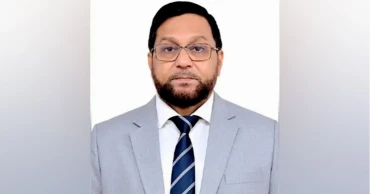
CID Chief Mosleh Uddin made DMP Commissioner
The government has appointed chief of the Criminal Investigation Department (CID) Additional Inspector General of Police (IGP) Mosleh Uddin Ahmed as Dhaka Metropolitan Police (DMP) Commissioner.
The Home Ministry issued a notification in this regard on Sunday which will come into effect soon.
18 days ago
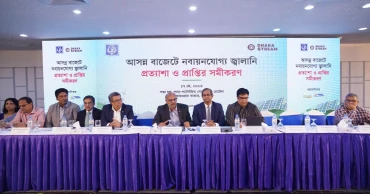
Fossil fuels swallow 80% of Bangladesh's power budget, renewables lag far behind: CPD
Renewable energy (RE) accounts for only 5 percent of Bangladesh's revised development budget allocation for the power and energy sector in the current fiscal year, while fossil fuel-based infrastructure continues to absorb nearly 80 percent of the allocation, according to a new study by the Centre for Policy Dialogue (CPD).
The findings were presented Sunday at a city hotel during a CPD programme titled "Renewable Energy in the Upcoming Budget: Expectations and Reality."
Prime Minister's Adviser on Finance and Planning Rashed Al Mahmud Titumir attended as chief guest. The session was moderated by CPD Research Director Khondaker Golam Moazzem, and the paper was presented by Programme Associate Md. Khalid Mahmud.
The study, titled "Renewable Energy in the National Budget 2026-27: Overshadowed by Fossil Fuels?", found that renewable energy projects account for only 3 percent of the total power and energy project budget and receive a mere 5 percent of the revised FY2026 allocation, amounting to BDT 795 crore, while fossil fuel-based projects command 87 percent of the total project budget and 79 percent of actual allocation.
Bangladesh has spent over BDT 1,474 billion subsidising fossil fuel-based power generation between FY2020-21 and FY2024-25, the study noted. The subsidy burden surged to BDT 620 billion in the revised FY2024-25 estimate, against an expected BDT 350-370 billion for the current year.
Bangladesh provides the highest energy subsidy as a share of the sector budget, around 34 percent, among selected Asian countries, the paper said.
The study also flagged that the FY2025-26 budget omitted a BDT 100 crore renewable energy allocation that had been included in the previous fiscal year, and introduced no new incentives for solar or other clean energy technologies.
Bangladesh's total installed renewable energy capacity currently stands at approximately 1,745 MW, with solar photovoltaic dominating at 83 percent of the total. The share of renewables in the country's total installed capacity remains at just 5.39 percent. The compound annual growth rate of renewable capacity from 2016 to May 2026 was recorded at 15.78 percent.
On the private sector front, the study noted that while 168 MW of solar projects were completed in FY2024-25, some 321 MW are currently under construction and over 5,254 MW remain in the tendering or planning phase, raising concerns about the pace of the procurement process.
Bangladesh floated four tender packages for a combined 5,238 MW of renewable capacity between December 2024 and March 2025, but the rounds drew limited investor interest, requiring repeated deadline extensions. The government has also cancelled 31 letters of intent covering 3,287 MW of capacity, projects worth around USD 6 billion in foreign investment, triggering 11 High Court petitions.
The CPD study identified high import duties as a key barrier, with lithium-ion batteries facing a total tax incidence of 61.80 percent and solar inverters facing 28.73 percent. It called on the National Board of Revenue (NBR) to adopt a full-chain duty waiver across the entire solar value chain rather than selective relief on individual components.
Among its recommendations, the study urged the government to establish a standalone Renewable Energy Development Fund with ring-fenced allocations, create a dedicated Ministry of Renewable Energy, restructure SREDA into a statutory regulatory body with enforcement authority, and adopt a rolling three-year RE budget commitment to give investors long-term fiscal visibility.
The paper also recommended a phased, legislated reduction in fossil fuel subsidies tied to verified renewable capacity additions, introduction of a direct RE promotion subsidy, and a dedicated budget allocation for the National Rooftop Solar Programme launched in July 2025. The country has an estimated rooftop solar potential exceeding 100 GWp and a gross wind energy potential of over 30 GW.
To meet the government's target of generating 10,000 MW from solar by 2030, the study said Bangladesh would need to install approximately 1,662 MW annually from January 2026 onward, a pace that would require a substantially different budgetary posture than currently on offer.
18 days ago
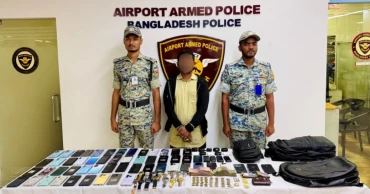
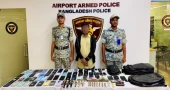
Ringleader of Ogyan party gang held at Dhaka airport
Members of Airport Armed Police Battalion (APBn) on Saturday arrested the ringleader of ‘Ogyan Party’ gang from Hazrat Shahjalal International Airport.
The arrestee was identified as Tajul Islam, 48.
The APBn members, led by assistant superintendent of police Fouzul Kabir Moin, conducted a drive at the airport area and arrested him, said Anita Rani Sutradhar, additional superintendent of APBn (operation) while speaking at a press briefing on Sunday.
Based on the information provided by the accused, the APBn members conducted a drive at a hotel in Darussalam area of the capital and recovered two mobile phones and Tk 2,23,000 in cash, 53.50 Saudi riyals, one Turkish lira and various other items belonging to victim Arafat Hossain.
Around 15 sedative tablets were also recovered from the bag containing the accused.
When briefing, Anita Rani, said on May 16, victim Arafat Hossain, 18, came to Hazrat Shahjalal International Airport to see off his cousin.
After the farewell, while staying in the departure area, Arafat Hossain drank coffee offered by accused Tajul Islam and later became unconscious.
During primary interrogation, Tajul confessed that they go to bus and railway stations and build familiarity with targeted individuals through conversation.
Later, they mix sedative drugs with tea, coffee or soft drinks, make them unconscious and steal their belongings, said Anita Rani.
A case was filed in this connection.
18 days ago
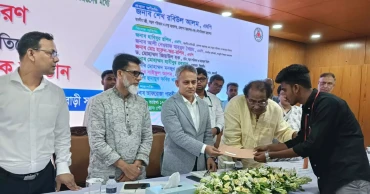
Most road accidents caused by unskilled drivers, faulty vehicles: Road Transport Minister
Road Transport and Bridges Minister Shaikh Rabiul Alam on Sunday said most road accidents in Bangladesh occur due to unskilled drivers and faulty vehicles.
He also blamed public unawareness and the movement of all types of small and large vehicles on the same roads as major causes behind frequent accidents.
The minister came up with the remarks while addressing a cheque distribution and public awareness programme on road accident prevention at the Rajbari municipality auditorium, organised jointly by the district administration and Bangladesh Road Transport Authority (BRTA).
Referring to the recent bus sinking incident at Daulatdia ferry ghat, the minister said driver incompetence, negligence, reckless behaviour and unfit vehicles were responsible for the tragedy.
He said the government has undertaken a Tk 2,800 crore project with financial support from the World Bank to reduce road accidents.
Under the project, around 60,000 drivers will be brought under training programmes, he said.
Regular activities including driver training, eye tests, blood pressure checks and drug screening would be conducted to improve road safety, he said.
He also urged all to be more careful and aware as the government is moving forward with all necessary plans to prevent accidents.
Speaking at the programme, State Minister for Road and Transport and Bridges Ministry, Habibur Rashid said ensuring road safety has become a demand of the time.
“Development becomes meaningful only when people remain safe. Discipline must be restored in the transport system and road management,” he said, urging all concerned to work responsibly and take coordinated initiatives to prevent accidents.
State Minister for Cultural Affairs and Rajbari-1 MP Ali Newaz Mahmood Khyom said there is no alternative to constructing a second Padma Bridge on the Daulatdia-Paturia route to reduce accidents.
Noting that movements for the Padma Barrage and another Padma Bridge have continued since 1994, he also said that the Padma Barrage project has already received approval from the Executive Committee of the National Economic Council (ECNEC).
He also sought the minister’s cooperation in implementing the second Padma Bridge project considering the needs of the neglected and underdeveloped people of the region.
18 days ago