others

Narsingdi farmer injured during quota protests dies at DMCH
A 44-year-old man who was injured during the quota reform protests in Narsingdi died on Wednesday while undergoing treatment at Dhaka Medical College Hospital (DMCH).
Abdur Rahman passed away at the DMCH ICU at 7:15 am, confirmed Inspector Bachchu Mia, in-charge of DMCH Police Outpost.
Quota protest deaths: Mourning day today
A farmer and also an assistant Kazi, Rahman hailed from Dokkhin Choga village under Narsingdi Sadar upazila. He was admitted to DMCH on July 20 after he was injured in a clash at Panchdona Mor in Narsingdi. He was shot in the back, said his brother-in-law Abul Bashar.
The dead body is kept in the DMCH morgue for autopsy, said Bachchu Mia.
Home Minister reports 147 deaths in quota reform protest violence
Earlier, Home Minister Asaduzzaman Khan reported on Sunday that 150 people have died during the violence surrounding the quota reform protests.
“Among the deceased were students, activists, police officers, Awami League leaders and individuals from various professions,” the home minister said.
Writ petition seeks directives to identify those responsible for deaths of 4 children inside their homes
1 year ago
Nine-point Demand: Some Khulna protesters call for withdrawal of movement while others vow to continue
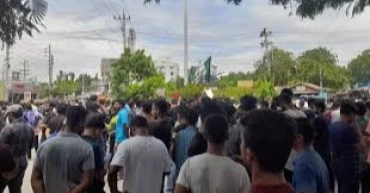
Amid the ongoing protests to realize a nine-point demand, a division has become apparent among Khulna activists. While one faction has decided to withdraw the movement, another group remains adamant about continuing the protests.
On Tuesday night around 11pm, a meeting was held at the Khulna Circuit House. Key attendees included Khulna City Corporation Mayor Talukdar Abdul Khalque, local lawmaker SM Kamal, Khulna’s Additional Deputy Commissioner Nazmul Hussain Khan, Khulna Metropolitan Police’s Deputy Commissioner Rakibul Hasan, Khulna city Jubo League President Shafiqul Rahman Palash and General Secretary Sheikh Shahjalal Hossain Sujan, Khulna city Chhatra League General Secretary Assaduzzaman Russell, and Khulna University’s Students Affair Assistant Secretary Mohammad Rakibul Hasan Siddiqui. Eleven protesters representing seven educational institutions, including Khulna University (KU), also participated.
KU student Jahurul Tanvir, who was present at the meeting, noted the lack of a formal coordinator for the university’s unit of the movement. “Students have spontaneously participated in past movements,” he said. “We attended the discussion through our teachers. The lawmaker and administrative officials assured us of justice for all deaths, including KU students, through proper investigation.”
Tanvir added that they decided to withdraw their program to prevent any group from inciting violence under the guise of the movement.
Rafsan Jany, representing Azam Khan College, confirmed their decision. “The lawmaker thanked us for observing the programs peacefully, and we have withdrawn our activities,” he said.
Lawmaker SM Kamal assured the students, “No case will be lodged against students in Khulna. If any cases are lodged, they will be withdrawn.”
However, not all protesters agreed with this decision. On messaging platform Telegram, a faction led by coordinator Miraj announced their intention to continue the movement. They alleged that KU students were coerced into holding a press conference to announce the withdrawal.
“We cannot abandon our nine-point demand,” said one protester from Miraj’s group. “Our fight for justice must continue.”
1 year ago

Students stage demonstration in Chandpur as part of ‘March for Justice’ amid heavy rain
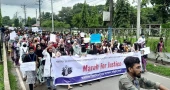
Students staged demonstrations in the district town on Wednesday to extend support to ‘March for Justice’ programme announced by Anti-Discrimination Student Movement.
They staged protests in front of Chandpur district judge court and the Deputy Commissioner’s office covering their faces with red cloth as a symbol of resistance.
March for Justice: Police lob sound grenade, tear shells to disperser protesters in Sylhet
Defying heavy rain, the protests began around 1 pm with students gathering on the north side of the Chandpur-Cumilla regional road, near the DC office.
Attempts by the students to enter the District Judge Court were thwarted by police, who redirected them to the roadside, where the demonstration continued.
Over 20 detained from students’march progrmmae in Khulna
The students alleged that government forces and ruling party affiliates had resorted to violence against protesters during the quota reform movement, resulting in the deaths of students and civilians. They also accused the police of arresting innocent students and sending them to jail.
Additional Superintendent of Police Rashedul Haque Chowdhury said, "We have encouraged the students to protest peacefully and have explained the importance of avoiding disorder and protecting public property. The district police have exercised maximum patience and tried to keep the situation under control.
1 year ago
Over 20 detained from students’march progrmmae in Khulna
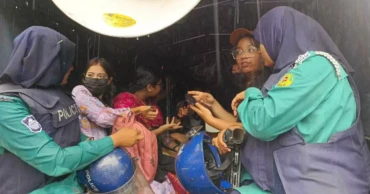
Police allegedly picked up over 20 students from Khulna city’s Royal and Moilapotha intersections respectively on Wednesday during their bid to bring out a procession in favour of ‘March for Justice’ programme to press home their nine- point demand.
Witnesses said the protesters started gathering at the intersections responding to their scheduled programme around 12:30pm.
At one stage, police began chasing them while a group of the protesters took position inside Ahsanullah College after locking the entrance.
But breaking open it, police detained over 20 protesters from the college, said witnesses.
March for Justice: Students-police clashes leave 15 Injured in Barishal; 10 detained
Around 1:30pm, a group of Bangladesh Chhatra League activists equipped with sticks took out a procession from Dalmill intersection while police chased them assuming to be protesters, they said.
As of filing this report around 2pm, a section of the protesters took position in the Royal intersection, resulting in a tense situation in the city.
On Tuesday night, protesters under the banner of the Anti-Discrimination Students’ Movement, announced the ‘March for Justice’ program, to stage demonstrations at educational institutions, court premises, and major roads across the country.
1 year ago
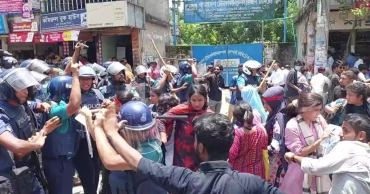
March for Justice: Students-police clashes leave 15 Injured in Barishal; 10 detained
At least 15 people including two photo journalists were Injured in clashes between police and students demonstrating as part of March for Justice programme in different areas of Barishal city on Wednesday.
At least 10 students were detained by the Kotwali thana police.
When the protesters tried to bring out a procession at Sadar road in the town police obstructed them, triggering a clash, said witnesses.
Students threw brick chips towards police while police charged batons to disperse them.
During the clashes, two journalists, Shamim Ahmed of Daily Jugantor and Mohammad Tuhin of Jamuna TV, were reportedly beaten by law enforcers.
March for Justice: Protesters, some DU teachers heading towards SC premises
At one stage, the clash spread to the entire area including Sadar Road, Fakir Bari Road.
The situation calmed down a bit when the students took shelter in different alleys in the face of police chase and reckless baton charges, reports our correspondent from the spot.
Meanwhile, another group of students faced police resistance when tried to march towards the Barishal court area on Fazlul Haq Avenue as part of a previously announced program.
The students were chanting “We Want Justice” and were blocked from entering the court premises, leading to further clash with the police.
Clashes were broke out at Kakli’s intersection, Bot Tala, and the Polytechnic Institute area.
Barishal Police Commissioner Jehadul Islam stated, “We are handling the situation with patience. The situation is under our control.”
1 year ago
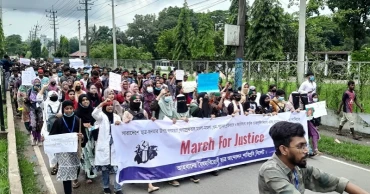
March for Justice: Police lob sound grenade, tear shells to disperser protesters in Sylhet
Police dispersed protesters when they attempted to march towards Subidbazar area of Sylhet city on Wednesday (July 31, 2024) as part of ‘March for Justice’ programme announced by Anti-discrimination Student Movement to press home their 9-point demand.
The protesters started taking position at the main gate of Shahjalal University of Science and Technology (SUST) from 11 am. Police who had taken position there before their arrival obstructed them, said witnesses.
Later, more students joined and started chanting slogans.
At around 12:30 pm, hundreds of students marched to the city's court point.
Read more: Tense situation as protesters hold ‘March for Justice’ demonstration in Chattogram Court premises
A clash broke when the protesters tried to move towards Subidbazar and police restored to tear gas shells and sound grenade to disperse them, reports our correspondent from the spot.
1 year ago
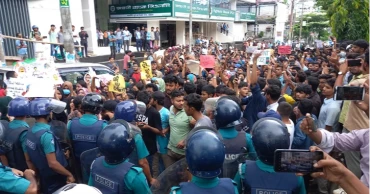
Tense situation as protesters hold ‘March for Justice’ demonstration in Chattogram Court premises
As part of the nationwide ‘March for Justice’ programme on Wednesday (July 31, 2024), protesters are holding a demonstration at the Chattogram Court premises to press home their nine-point demand.
A tense situation prevails in and around the court area as a significant number of law enforcers have surrounded the protesters, according to UNB’s Chattogram correspondent.
Earlier, around 11:30 am, protesters began gathering in front of Chattogram Zilla Parishad in Laldighi area, occupying the busy Laldighi Road for about half an hour, causing a traffic gridlock on both sides.
A group of lawyers from the court later joined the protesters, extending their support. In response, the police administration issued a half-hour ultimatum for the protesters to vacate the road.
The combined group of protesters and lawyers then marched to the front of the Lawyers’ Building, where they continued to demonstrate and chant slogans.
Read more: Shamim Osman seeing signs that tonight 'not normal'
1 year ago

Office hours back to regular schedule Wednesday
Employees and staff of different government and private offices joined their work according to their normal schedule from Wednesday following the government’s decision.
People were seen in a hurry to reach their destinations in the morning while all modes of vehicles were plying on the roads.
However, decision is yet to come about the reopening of the educational institutions closed due to students' quota reformation movement.
Education Minister announces educational institutions to open gradually, but still no date
The law enforcers were seen taking position in their designated places like before to maintain law and order situation and they kept a vigil on the overall situation.
Earlier on Tuesday, the Public Administration Ministry made an announcement to run all offices as per regular schedule aiming to bring the situation to normal gradually.
Meanwhile, the government announced a relaxation of the ongoing nationwide curfew from 7 am to 8 pm for four days starting from today in Dhaka, Narayanganj, Gazipur, and Narsingdi districts, Home Minister Asaduzzaman Khan said on Tuesday.
Amid the widespread violence over the quota reform protest, the government imposed a curfew from Friday midnight.
The government in an executive order declared general holidays on July 21, 22 and 23.
On July 24, the Public Administration Ministry fixed the office hours from 11 am to 3 pm for July 24 and July 25 amid countrywide curfew imposed on July 19.
Curfew in Dhaka, 3 other districts to be relaxed from 7 am to 8 pm from tomorrow: Home Minister
Later, the government set office timing from 9 am to 3 pm for July 28 to 30.
Some 150 people have died during the violence surrounding the quota reform protests across the country, according to government estimate. Unofficial death toll has crossed 200.
1 year ago
Dhaka's air quality ‘unhealthy for sensitive groups’
Dhaka ranked 9th on the list of cities worldwide with the worst air quality with an AQI score of 135at 9:01 am this morning.
Dhaka's air was classified as 'unhealthy for sensitive groups', according to the air quality index.
Pakistan's Lahore, Uganda’s Kampala and Indonesia’s Jakarta occupied the first, second and third spots on the list, with AQI scores of 213, 176 and 172 respectively.
Dhaka’s air quality continues to be in ‘moderate’ zone this morning
When the AQI value for particle pollution is between 50 and 100, air quality is considered 'moderate', between 101 and 150, air quality is considered 'unhealthy for sensitive groups', between 150 and 200 is 'unhealthy', between 201 and 300 is said to be 'very unhealthy', while a reading of 301+ is considered 'hazardous', posing serious health risks to residents.
The AQI, an index for reporting daily air quality, informs people how clean or polluted the air of a certain city is and what associated health effects might be a concern for them.
The AQI in Bangladesh is based on five pollutants: particulate matter (PM10 and PM2.5), NO2, CO, SO2, and ozone.
Dhaka has long been grappling with air pollution issues. Its air quality usually turns unhealthy in winter and improves during the monsoon.
As per World Health Organization (WHO), air pollution kills an estimated seven million people worldwide every year, mainly due to increased mortality from stroke, heart disease, chronic obstructive pulmonary disease, lung cancer, and acute respiratory infections.
Dhaka’s air quality continues to be ‘moderate’
1 year ago
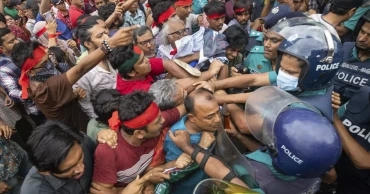
Bangladesh mourns some 200 deaths as student protests wind down and thousands are arrested
Bangladesh observed a day of mourning Tuesday in memory of more than 200 people killed in recent weeks during violence that evolved from student protests over the South Asian country's quota system for government jobs.
After weeks of peaceful protests by students looking to change the system — which reserves 30% of government jobs for relatives of veterans and freedom fighters during the war of independence against Pakistan in 1971 — violence erupted on July 15 when activists of a student wing of the ruling party attacked demonstrators. Security officials opened fire, using tear gas and rubber bullets to try to quell the violence.
The quota protests posed the most serious challenge to Bangladesh’s government since Prime Minister Sheikh Hasina won a fourth consecutive term in January elections that the main opposition groups boycotted.
The ruling Awami League party and opposition Bangladesh Nationalist Party have often accused each other of fueling political chaos and violence, most recently ahead of the election, which was marred by a crackdown on several opposition figures.
Government officials — including those at the Bangladesh Secretariat, the top office containing most of the country’s ministers and bureaucrats — wore black badges Tuesday to mourn those killed in the violence.
Bangladesh is slowly crawling back to normalcy with the strict curfew being relaxed in recent days. Authorities also asked all mosques, temples and other religious installations to organize special prayers Tuesday for the dead.
Later Tuesday, Hasina visited a state-run hospital in the capital of Dhaka, where many of the injured were being treated. She asked hospital authorities to ensure the best possible care.
Also on Tuesday, members of 31 cultural groups tried to hold a procession in downtown Dhaka, condemning the deaths in the violence but police blocked it. No violence was reported as singers and other activists sat down on the street and continued the protests peacefully amid a tight police cordon.
Home Minister Asaduzzaman Khan put the overall death toll at 150, while the country’s leading Bengali-language daily, Prothom Alo, said 211 people have been killed since the violence erupted on July 15 while thousands of others have been injured.
Media reports said about 10,000 people have been arrested over the past two weeks in relation to clashes at protests and other attacks on state properties. Rights groups have called for an end to arbitrary arrests, and critics accused the government of using excessive force to tamp down the violence.
“The mass arrest and arbitrary detention of student protesters is a witch hunt by the authorities to silence anyone who dares to challenge the government and is a tool to further perpetuate a climate of fear," Smriti Singh, regional director for South Asia at Amnesty International, said in a statement Monday.
“Reports suggest that these arrests are entirely politically motivated, in retaliation for the exercise of human rights,” Singh said.
The government has defended its position, saying that the arrests were being made on specific charges, and reviweing CCTV footage and on the basis of evidence.
Six of the protest coordinators being held in custody by the Detective Branch of the Dhaka Metropolitan Police released a statement calling off the protests, but other demonstrators rejected the video statement, claiming it was coerced.
They say they will protest until all their demands are met, including a public apology from Hasina, the prime minister.
Police said the six coordinators were taken into custody for their safety, and their families met them on Monday. A video was posted showing the six having a meal with the head of the Detective Branch in Dhaka, Harun-or-Rashid.
Rights activists have demanded the six be released so that they can return to their families.
Protesters said the 30% quota was discriminatory and benefited supporters of Hasina, whose Awami League party led the independence movement, and urging that it be replaced by a merit-based system.
On July 21, the Supreme Court ordered that the 1971 war veterans’ quota be cut to 5%. Of the remainder, 93% of civil service jobs would be merit-based, while the remaining 2% would be reserved for members of ethnic minorities, transgender people and those with disabilities. Two days later, the government accepted the ruling and pledged to execute the decision.
The status of the 1971 war veterans remains a charged issue in Bangladesh as the quota had also applied to women raped by Pakistani soldiers and their collaborators during the war for independence — and their children. These women have been recognized as “freedom fighters” for the ordeal they suffered.
Both broadband and mobile data services were restored Tuesday after a dayslong internet blackout, but social media platforms including Facebook remained blocked. Banks and offices opened under a relaxed curfew. Schools and other educational institutions were closed with no opening date yet set as police continued to grapple with protesters.
1 year ago