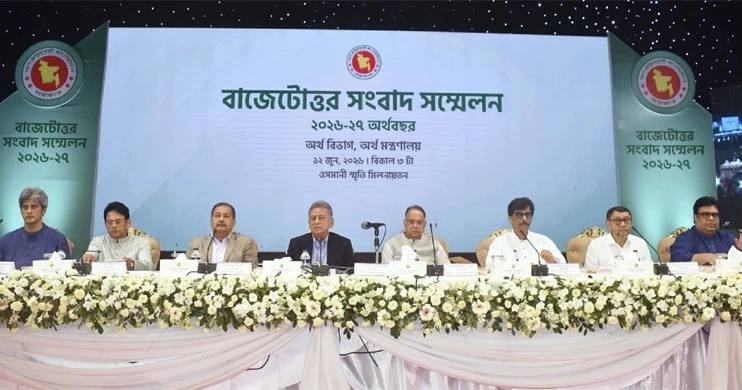
Finance Minister Amir Khosru Mahmud Chowdhury has said the government expects inflationary pressures to ease gradually through structural reforms aimed at reducing the cost of doing business, improving efficiency and strengthening supply chains.
“Inflation in Bangladesh is not a short-term phenomenon but the result of several years of accumulated pressures, compounded by global conflicts, rising import costs and weaknesses in the banking sector,” he said today (Friday), while addressing a post-budget press conference at the Osmani Memorial Auditorium.
The finance minister, who presented his first budget yesterday, noted that inflation has remained above 9 percent for the past three years. External factors, including conflicts in the Middle East, have pushed up global commodity prices, while capital shortages in banks caused by loan defaults, fraud and money laundering have increased the cost of funds.
He said that imported goods had become more expensive due to global developments and that Bangladesh had limited control over such external inflationary pressures.
However, the government could reduce domestic inflation by lowering business costs through deregulation, administrative reforms and improved efficiency, he said.
According to Amir Khosru, businesses in Bangladesh face excessive costs due to lengthy approval processes, bureaucratic delays, high borrowing costs, inefficiencies at ports and weaknesses in taxation and regulatory systems.
“Inflation cannot be controlled by deploying police, regulatory agencies or government officials in markets. It has to be managed through sound policies and efficient administration,” he said.
The newly elected BNP government's first budget set an inflation target of 7.5% for the next fiscal, against a GDP growth expectation of 6.5%.
Khosru said the government would focus on improving ease of doing business, reducing unnecessary regulations and ensuring greater transparency across public institutions. He added that reforms in ports, logistics and procurement systems would also help lower costs.
The finance minister stressed the need for long-term procurement planning, saying Bangladesh should maintain strategic reserves of fuel, food and fertiliser to reduce vulnerability to global market shocks.
Referring to energy imports, he criticised past reliance on spot purchases and said the government intended to pursue longer-term procurement arrangements to secure better prices and ensure energy security.
On the government’s decision to increase salaries for public servants, Khosru said the move was necessary to address rising living costs after years without significant adjustments.
“When people face financial hardship, the tendency towards corruption increases. Improved salaries should help reduce that pressure while ensuring a better standard of living for government employees,” he said.
The finance minister also highlighted employment generation as a central objective of the budget, saying investments in education, skills development and private-sector growth would help create jobs both at home and abroad.
He said the government had placed particular emphasis on vocational education, reskilling and upskilling programmes to improve employability, especially among young people and educated jobseekers.
“Investment means employment. Our focus is on creating demand for jobs through increased investment and improved skills,” he said.
Khosru said the budget represented a shift from traditional approaches and reflected changing global economic realities.
He reiterated the government’s commitment to reducing dependence on domestic bank borrowing, which he said often crowded out private-sector lending. He noted that planned borrowing from local banks had already been reduced compared with the previous fiscal year and that the government would continue this trend in the coming years.
The minister also defended the budget’s emphasis on social protection programmes, saying the largest investments were being made in initiatives designed to support low-income and vulnerable groups.
Programmes such as the Family Card, support for farmers, universal healthcare and preventive healthcare services were aimed at improving living standards while preparing beneficiaries for better employment opportunities, he said.
Khosru placed special emphasis on the government’s proposed “creative economy” initiative, which seeks to integrate artisans, cultural workers, performers and rural entrepreneurs into the mainstream economy.
He said the programme would provide financing, training, design support and market access to traditional craftsmen, weavers, potters, musicians and other creative workers whose contributions had long remained outside formal economic planning.
The minister said the government had allocated Tk 800 crore to launch creative economy initiatives, including creative centres, cultural districts, tourism-linked projects and heritage restoration programmes.
“Our objective is to monetise culture and creativity so that artists, craftsmen and performers can improve their livelihoods while contributing to economic growth,” he said.
Khosru also said the government was reviewing outdated mouza land valuation rates, which are often significantly below market prices, to curb opportunities for whitening undisclosed income through property transactions.
A committee has been formed to revise mouza rates and bring them closer to actual market values, although he acknowledged that the exercise would require a nationwide survey and could not be completed before the budget.
Responding to concerns about implementation, the finance minister said the government would establish a high-powered task force and an online complaint platform to monitor reform measures and ensure accountability.
“No one will be exempt from scrutiny if delays or violations occur. We are committed to implementation,” he said.
Earlier, in his opening remarks, Khosru described the budget as an “inclusive” one prepared under exceptional circumstances within less than two months of the new government’s formation.
He said the budget sought to move away from what he described as a patronage-based economic model and instead promote “economic democratisation” by extending opportunities to all sections of society.
The minister said the government inherited an economy weakened by institutional erosion, financial mismanagement and global economic uncertainty, making budget preparation particularly challenging.
He added that future public spending and development projects would be evaluated on four key criteria: value for money, return on investment, job creation and environmental sustainability.
“The budget is for all Bangladeshis. No group, profession or community has been left outside its scope,” he said.