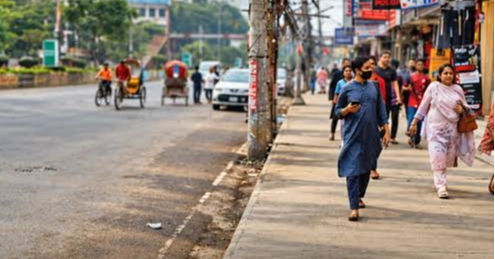
Footpaths and roadside areas in and around Mirpur-10 have remained free of hawkers for the first time in recent memory following an eviction drive by the Dhaka North City Corporation (DNCC) on September 30.
The areas include Mirpur-10 Golchakkar, Hope School and its adjoining areas, the Mirpur BRTA office, Hermann Gmeiner School and College area, and the main road on both sides heading towards the Mirpur-10 Fire Service Training Complex.
Where once these areas were teeming with hawkers selling everything from t-shirts to utensils, a visit to the same area on Tuesday found no hawkers - none - occupying any space at all on the footpaths or roads, like they did prior to the eviction drive.
Continuous monitoring by both the municipality and police has been essential to prevent the situation from reverting to what it was a week ago, local residents said. They insisted that the authorities must continue the focused monitoring in order to prevent the hawkers from returning.
Mirpur-10 has seen many such eviction drives in the past. On each occasion, within days of the eviction drive conducted in the area, the hawkers would all return and occupy the footpaths and roads within a few days.
“This time, after the eviction drive, hawkers have not been able to sit on the roads as monitoring is continuing,” says Sohel Mia, one of the evicted hawkers who sold mobiles.
Russel Mia, who used to sell pomelo and hog plum in front of the Mirpur-10 Fire Service station, also said hawkers had stopped sitting on the roads following the recent eviction drive.
For regular pedestrians, the change has brought visible, immediate relief. There is clearly more space to walk, resulting in a much more pleasant experience for pedestrians, even if you’re in a hurry to get somewhere.
Samia, who regularly uses the footpath, said it had been a nightmare trying to walk through crowds of hawkers, not to mention their customers, in Mirpur-10 till a week back.
“Sometimes I would even collide with other pedestrians while walking. After the eviction drive, we can now move around peacefully,” she said, urging the city corporation and police to continue their monitoring and vigilance against hawkers coming back one day
Habiba, a Class XII humanities student of Mirpur Girls Ideal School and College, recalled how garbage used to accumulate in front of their college gate when hawkers used to occupy the footpath (pavement).
“As a result, we faced difficulties entering and leaving the college. Sometimes we had to push through the crowd to get out,” she said.
She also confirmed now that the footpath has been cleared, there is no garbage outside the college boundary in front of the gate.
But are they being missed as well? Believe it or not, they are, and by some very unlikely sources.
The vast majority of people UNB spoke to clearly welcomed the eviction, and consider themselves better off in its aftermath.
Others like Hafsa Ahmed Brishti, an HSC examinee of Pallabi School and College, said hawkers offered both advantages and disadvantages.
“The advantage was that we could buy clothes and other necessary items at low prices. But it was difficult to walk comfortably on the footpath,” she said.
She said she sometimes experienced people deliberately bumping into her while walking, which made her uncomfortable.
“Now I can walk comfortably on the clear footpath and I feel very good. But I do miss the opportunity to buy some things at low prices,” she said.
The most surprising discovery our correspondent made was that the hawkers were being missed by some businesses operating in nearby markets.
Kulsom has been running the All is Well Fashion outlet opposite Green Leaf School and College for two years now, selling women's three-piece dresses and other items.
She said when hawkers filled up the footpaths with various products, their presence contributed to greater footfall in the area, which is almost automatically assumed to be more desirable from a commercial point of view. Business, Kulsom seemed to suggest, was better when the hawkers were there and more customers from distant areas used to come to the locality.
“After the eviction, our sales have fallen to about one-fourth of what they were before,” she said.
According to Kulsom, customers now mainly comprise students from nearby schools and colleges, and their guardians.
She said if hawkers were allowed to operate in a limited and organised manner, customers could buy goods at lower prices while pedestrians and vehicles could also move through the roads and footpaths.
The eviction drive on September 30 had triggered a clash between hawkers and DNCC officials and law enforcement personnel in the area. At least two DNCC vehicles were set on fire and three bulldozers were vandalised. Several journalists who were simply there to cover the game also came under attack.
The scale of the violence unleashed that day had suggested to the authorities that they were facing a tough and desperate adversary in the form of the hawker community. The joint monitoring team DNCC formed comprising police, city corporation staff and local residents would have its work cut out for it.
A week later, it all seems to have been worth it