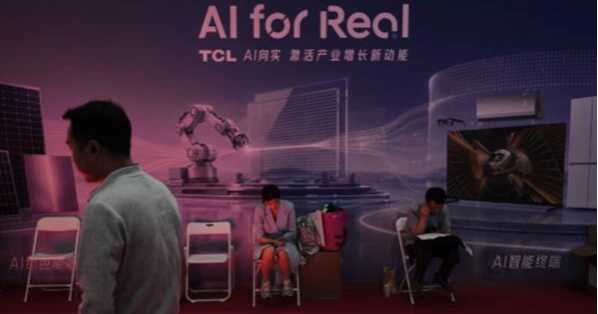
As artificial intelligence rapidly changes China's job market, workers are increasingly worried about being replaced, while others are learning to use AI to find new opportunities.
Computer programmer Fei Zhaojun experienced the change firsthand. His boss recently asked whether AI could soon replace human programmers. Two weeks later, Fei and about 160 colleagues lost their jobs at a Beijing company.
The 40-year-old had once doubted that AI could handle programming properly. But he now believes many mid-level coding jobs can be replaced.
"Even if it is a disaster that leads to replacing all humans, at this stage, you just have to use it as everyone else is using it," Fei said.
He is currently taking a career break and making short vlog-style videos about ordinary people's lives while deciding what to do next.
China is among the world's leading adopters of AI, with strong government support encouraging businesses and workers to use AI tools and robots.
Shujing He, a Beijing-based senior analyst at research and advisory firm Plenum, said there appears to be less opposition to AI in China than in some other countries.
"Individuals who worry about being replaced, as well as those who have already left traditional workplaces, are often eager to experiment with AI-enabled businesses and independent ventures," she said.
AI changes traditional jobs
Part-time translator Du Qinchun in Chengdu has been helping train an AI translation model. The work has temporarily brought him more opportunities, but he said wages in the translation industry have fallen by more than half compared with several years ago.
The spread of AI translation tools has also reduced interest in foreign-language university programs.
According to market research firm IDC, the share of Chinese industrial companies using AI models and AI "agents" rose to 47.5% last year from 9.6% in 2024.
AI and robotics are also moving into physical jobs. Humanoid robots are being tested for tasks such as sorting parcels, directing traffic and making coffee. Food delivery robots are spreading in some parts of the country, raising concerns about the future of millions of delivery workers.
Generative AI is also increasingly being used in China's short-drama industry for writing, production and distribution. Chinese media reports said the number of live-action short and vertical video series fell by about 75% in the first quarter of this year compared with the same period last year.
Plenum analyst He said jobs requiring specialized training are becoming easier to perform with AI, particularly in software development and multimedia production.
The International Labour Organization has also warned that women may face greater job risks from AI because they are more likely to work in roles that can be automated and remain underrepresented in science and technology.
AI brings both risks and opportunities
China's government is promoting its "AI Plus" initiative and a five-year plan through 2030 to expand AI across industries as the country competes with the United States in technology.
Zilan Qian, a research associate at Oxford China Policy Lab, said China's strong government support could allow AI to spread across different sectors faster than in many other countries.
The rapid adoption comes as China's economy faces other challenges. Consumer spending has remained weak partly because people are worried about job security, while a long-running housing downturn has reduced household wealth.
Cornell University economics professor Eswar Prasad said China's technology sector could increase productivity but may not create enough new jobs.
"AI is likely to lift productivity across the board but could have a severe disruptive effect on employment," he said, warning that this could worsen employment problems and affect social stability.
China's overall urban unemployment rate is around 5%, while unemployment among people aged 16 to 24, excluding students, is about three times higher.
However, some experts believe AI could become useful as China's workforce shrinks. The country's population is aging rapidly, and by 2050 there are expected to be fewer than two working-age adults for every retiree.
"Automation could partially offset a shrinking workforce rather than being purely a threat to it," said Xuenan Cao, a professor at San Francisco Bay University.
Workers find new ways to adapt
Some Chinese workers are already using AI to build new careers.
Wang Zhicheng, 32, previously worked as a scriptwriter for a company producing 3D educational videos for children. He regularly used AI for brainstorming and fact-checking.
After the company laid off about half of its 13 scriptwriters, Wang resigned and began working independently, producing illustrated children's books.
He said AI can save time but its output is sometimes repetitive, formulaic and inconsistent.
"You can treat AI as a tool just like (Microsoft) Word," Wang said. "Humans are still the decision makers on which one to pick or pursue among all that AI generates."
For high school chemistry teacher Yang Zheng, AI is less of a threat and more of a useful classroom tool.
The 29-year-old said students can use AI to get immediate answers and ask follow-up questions, although the technology sometimes makes mistakes.
"It is a good thing for students as it generates in real-time so that students can ask follow-up questions," Yang said. "It often gets things wrong, but it improves over time."