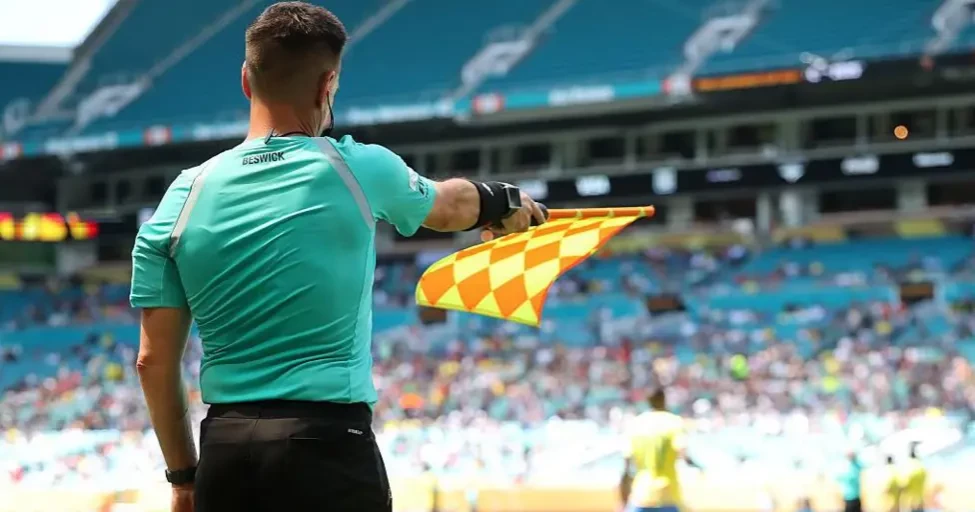
FIFA has announced a new generation of semi-automated offside technology for the 2026 World Cup, a move aimed at speeding up decisions and reducing the need for assistant referees to delay raising the offside flag.
The upgraded system will work alongside the Video Assistant Referee (VAR) and send a real-time audio alert to assistant referees when a player is more than 10 centimetres offside. This is a significant improvement over previous versions tested at the Club World Cup and Intercontinental Cup, which only alerted officials when a player was more than 50 centimetres offside.
Under the new system, assistant referees will still have the final authority on when to raise the flag and stop play. They may choose to keep the flag down if they suspect a technical issue, although FIFA said multiple safeguards have been built into the technology to minimise errors.
The technology will not be able to determine extremely close offside calls and may face limitations when players are on the ground or clustered closely together. It will also only apply to positional offsides and cannot be used for subjective decisions, such as determining whether a player interfered with an opponent without touching the ball.
FIFA hopes the system will reduce frustration among players and fans by allowing quicker decisions and limiting unnecessary passages of play. It is also expected to lower the risk of injuries that can occur when play continues despite an apparent offside.
Concerns over delayed offside calls gained attention in May 2025 when Taiwo Awoniyi suffered a serious injury after colliding with a goalpost during a move where the assistant referee delayed raising the flag. The striker was later placed in an induced coma.
In another major innovation, FIFA confirmed it will create AI-powered 3D avatars of every player participating in the tournament to improve decision-making accuracy.
The process will involve digitally scanning all 1,248 players from the 48 competing teams. Each player will undergo a one-second scan during pre-tournament photo sessions. The resulting digital models will be used to generate clearer and more detailed offside animations for officials, broadcasters and fans.
New technology for ball out of play decisions
FIFA has also approved new technology capable of determining whether the ball crossed the touchline before a goal was scored.
The system will generate a 3D animation similar to goal-line technology, showing the precise position of the ball. A sensor inside the ball will also identify which player last touched it, helping VAR officials review decisions involving corners and other restart situations.
The move follows several controversial incidents, including one involving Aston Villa FC in February, when a goal against Brentford FC was disallowed amid uncertainty over whether the ball had gone out of play.
Enhanced offside reviews through goalkeeper perspective
FIFA is also expanding its "Real-time 3D Recreation" technology to help officials assess "line-of-sight" offside situations more effectively.
The system will provide virtual viewpoints replicating the perspective of both goalkeepers, allowing VAR officials and television audiences to better judge whether a player in an offside position obstructed a goalkeeper's vision.
Several controversial incidents during the past season involved debates over whether goalkeepers had their view blocked. FIFA believes the new technology will provide officials with an additional tool to make faster and more accurate decisions during such situations.
#From BBC