
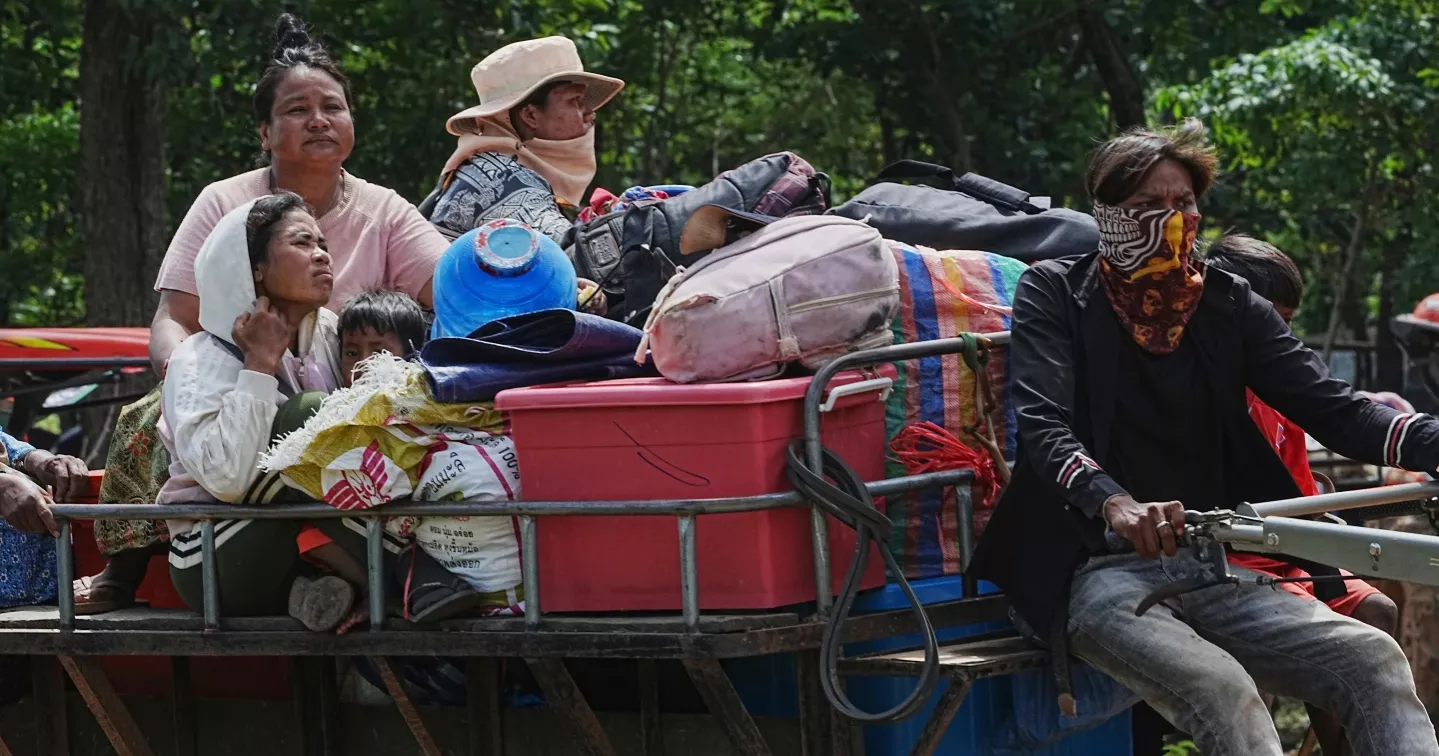
Fighting between Thailand and Cambodia entered its second day on Friday, forcing tens of thousands to flee and raising concerns of a wider conflict.
The U.N. Security Council is set to hold an emergency meeting on the crisis later Friday in New York. Malaysia, which chairs the ASEAN bloc that includes both nations, has called for a ceasefire and offered to mediate.
According to Thailand’s Health Ministry, over 58,000 people have been relocated to temporary shelters in four Thai provinces along the border. Cambodia reported that more than 4,000 residents near the frontier have also evacuated.
At least 14 people have been killed in Thailand, while Cambodia recorded its first fatality on Friday.
Clashes erupt after land mine blast
Tensions flared following a land mine explosion on Wednesday that injured five Thai soldiers in a disputed border zone.
Thailand’s military said fighting resumed early Friday in multiple areas, including Chong Bok and Phu Makhuea in Ubon Ratchathani province, and Phanom Dong Rak in Surin province. Exchanges of fire were also reported near the Ta Muen Thom temple. AP reporters near the border heard artillery fire from early morning.
Thai officials accused Cambodian troops of using heavy artillery and Russian BM-21 rocket launchers, prompting what they called “appropriate supporting fire” in response.
Thailand reported 14 deaths — one soldier and 13 civilians, including children — with 15 soldiers and 30 civilians wounded.
In Cambodia, Gen. Khov Ly said a man died after a Thai rocket struck a Buddhist pagoda in Oddar Meanchey province. Four civilians were also injured on Thursday.
The Thai army denied targeting civilian areas and accused Cambodia of placing weapons near residential zones, using people as “human shields.”
Border villages empty as residents flee
As the conflict worsened, many residents on both sides abandoned their homes.
Thailand-Cambodia border clashes escalate, at least 12 dead as airstrikes begin
In Surin, about 600 people took shelter in a university gymnasium, 80 kilometers from the border. Some sat in groups on blankets and mats, while others lined up for meals.
Seamstress Pornpan Sooksai, who brought along four cats in two cages, said she was doing laundry when she heard explosions near the Ta Muen Thom temple. “I was terrified,” she said.
Another evacuee, Rattana Meeying, recalled living through the 2011 conflict, but said this time felt more violent. “Children and the elderly were struck without warning,” she said.
At Phanom Dong Rak hospital, windows were shattered and the roof damaged by shelling on Thursday. Explosions could still be heard on Friday as injured soldiers arrived, including one who lost both legs.
In Sisaket province, long lines of vehicles were seen as villagers obeyed evacuation orders.
Across the border in Cambodia, villages in Oddar Meanchey were nearly deserted. Residents had locked homes and fled, while livestock roamed freely. Some had dug makeshift bunkers using wood and metal sheets.
Several hundred Cambodians gathered at a remote Buddhist temple surrounded by rice fields, sheltering under plastic tents. Women rocked babies in hammocks as children played nearby.
Veng Chin, 74, urged both governments to find a peaceful solution. “I want to go home and work on my farm,” he said.
ASEAN and UN urge calm
The ongoing hostilities mark a rare military clash between ASEAN member states. While Thailand has had previous border tensions with Cambodia and Myanmar, this conflict has drawn broader attention.
Malaysian Prime Minister Anwar Ibrahim, speaking as ASEAN chair, said he spoke to Cambodian leader Hun Manet and Thai Acting Prime Minister Phumtham Wechayachai, encouraging peaceful dialogue. Malaysia is ready to mediate, he added.
Over 100 aid organizations warn of worsening starvation in Gaza amid ongoing Israeli strikes
U.N. Secretary-General Antonio Guterres has also called for restraint and dialogue, according to deputy spokesperson Farhan Haq.
History of border tensions
The 800-kilometer border between Thailand and Cambodia has long been disputed. The last major escalation in 2011 left 20 people dead.
This latest conflict was triggered in May when a Cambodian soldier was killed. Though both sides initially agreed to ease tensions, measures like travel and trade restrictions kept the situation tense.
The land mine blast that injured Thai soldiers on Wednesday caused Thailand to withdraw its ambassador and expel Cambodia’s envoy. Land border crossings were shut, and Thai nationals were advised to return home, with airlines offering evacuation support.
Cambodia responded by recalling embassy staff from Bangkok and downgrading diplomatic ties.
Fighting resumed on Thursday, with both sides accusing each other of drone use and launching artillery. Thailand said it responded with airstrikes, including two bombing runs by F-16s.
Cambodia alleged that bombs landed near the Preah Vihear temple, a UNESCO World Heritage site. Phnom Penh shared photos of the reported damage and vowed to pursue justice internationally.
The conflict has also affected Thai politics. Prime Minister Paetongtarn Shinawatra was suspended from office on July 1 amid an ethics probe linked to a phone call with Cambodia’s former Prime Minister Hun Sen.
Source: Agency