Parliament
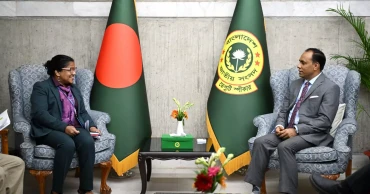
Deputy Speaker seeks UNDP assistance to modernise Parliament
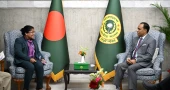
Deputy Speaker Barrister Kayser Kamal on Sunday sought technical and financial support from the United Nations Development Programme (UNDP) for implementing an e-Parliament initiative and strengthening parliamentary institutions.
He made the request when a UNDP delegation, led by UNDP Bangladesh Deputy Resident Representative Sonali Dayaratne, paid a courtesy call on him at his office in the Jatiya Sangsad Bhaban, according to a press release.
During the meeting, the two sides exchanged views on Bangladesh’s parliamentary democracy and discussed possible initiatives to further strengthen parliamentary practices and legislative functions.
Kayser Kamal said the present government is giving the highest priority to the education and health sectors.
5 days ago
Parliament’s budget session prorogued
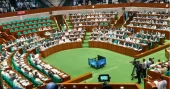
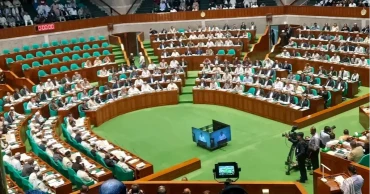
The 2nd session of the 13th Jatiya Sangsad, which was the budget session, was prorogued on Wednesday after 26 working days.
Deputy Speaker Kayser Kamal, who was chairing the House, read out the prorogation order of the President at 6:55pm.
During the session, Parliament passed a Tk 9,38,000 crore national budget for the 2026-27 fiscal year, which is the first budget under the current BNP government formed following the February 12 national election.
Earlier, the budget session started on June 7 and Finance Minister Amir Khosru Mahmud Chowdhury placed the budget in the House on June 11.
During the session, a total of 11 bills were passed, while 11 parliamentary committees, including the Special Committee for Constitutional Amendment and nine parliamentary standing committees, were constituted.
The bills include the Narcotics Control (Amendment) Bill 2026, the Invest Bangladesh Bill 2026 and the Gambling Prevention Bill, 2026.
A total of 278 questions were received for the Prime Minister while he answered 35 questions. The session received 5,031 questions for different ministries while the number of the answered questions was 3474.
9 days ago
Curb corruption, restore disciple in financial sector: Opposition Leader to Govt
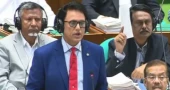
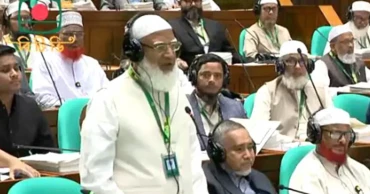
Opposition Leader Dr Shafiqur Rahman on Wednesday called upon the government to take stern actions against corruption and restore discipline in the financial sector, saying that no one, including lawmakers, should be spared if found involved in graft.
"If this Parliament does not become a patron of corruption, I am absolutely confident that corruption will leave Bangladesh with touching its ears (entirely)," he said.
The Opposition Leader said corruption cannot be eliminated if political patronage and favouritism continue. “Some blame bureaucrats, some blame businessmen and others blame politicians for corruption. I say the responsibility belongs to all of us. It is impossible to make any single sector corruption-free in isolation. It requires a coordinated effort," he said.
Referring to Prime Minister Tarique Rahman's earlier remarks that the government would "grab corruption by the throat," Shafiqur Rahman said the immediate priority should be to restrain corruption by "holding its hands."
"We want the government to restrain corruption by grabbing its hands first. Handcuff it, and if necessary, keep a cross-shackle on its foot and lock its mouth and then finally grab its throat,” he said.
“If anyone, including me or any member of this House, is involved in corruption, no one should be spared," said the opposition leader.
Shafiqur also called for restoring discipline in the banking, insurance, corporate and capital market sectors, saying Finance Minister Amir Khosru Mahmud Chowdhury had assured Parliament that restoring financial discipline was the government's top priority.
"We want to see that commitment reflected everywhere—from this Parliament to the banking sector, insurance, corporations and the stock market," he said..
Expressing deep sorrow over the deaths caused by recent floods in four divisions, particularly in Chattogram, the opposition leader urged the Prime Minister and the finance minister to consider providing special financial assistance to the families of those killed.
He thanked the government for allocating increased funds for the education and health sectors in the national budget for the 2026-27 fiscal year.
The Jamaat-e-Islami chief also proposed appointing designated religious teachers at the primary school level, saying religious education should begin from the early stages of schooling.
He called for ensuring equitable allocation of development funds for opposition lawmakers.
"We want a balanced distribution of funds," he said, urging the government to ensure fairness in allocating resources regardless of party affiliation.
Addressing the Speaker, Shafiqur expressed hope that he would continue to conduct the House firmly and impartially while ensuring strict adherence to the Rules of Procedure.
He recalled that on the first day of the Parliament, opposition members had called for breaking away from the negative political culture of the past.
"We said we would criticise the government, but within the grammar of Parliament. Alhamdulillah, I am pleased and partially convinced that there has been considerable improvement, though some negative practices still remain. I hope those will also disappear," he said.
The opposition leader also thanked the Prime Minister for announcing that the July Memorial Museum would be opened on August 5 and urged the government to ensure that the significance of the July movement is preserved prominently in the pages of the nation's history.
9 days ago
Parliament passes Invest Bangladesh Bill despite opposition objections
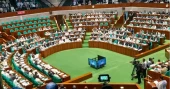
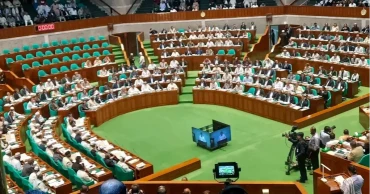
Parliament on Wednesday passed the Invest Bangladesh Bill, 2026, despite strong objections from the opposition, which criticised the government for introducing and passing the legislation on the same day without referring it to a parliamentary committee.
The bill, moved by Home Minister Salahuddin Ahmed, also the minister in charge of the Prime Minister's Office in Parliament, was passed by a voice vote after a lengthy procedural debate, with opposition MPs repeatedly protesting what they described as a violation of lawmakers' right to scrutinise legislation.
The new law abolishes the Bangladesh Economic Zones Authority (BEZA), the Bangladesh Public Private Partnership Authority (PPP Authority) and the Bangladesh Investment Development Authority (BIDA), replacing them with a single statutory body named Investment Bangladesh Authority.
As soon as the minister sought leave to introduce the bill, Bangladesh Jamaat-e-Islami MP Muhammad Nazibur Rahman objected, saying the proposed legislation repeals six existing laws and dissolves multiple authorities, making it too significant to be passed without proper examination.
He argued that although the Cabinet approved the bill on July 9, MPs were not provided with the mandatory documents within the stipulated notice period.
"We have not received any justification as to why the required documents were not supplied despite six days having passed since Cabinet approval," he said.
Nazibur also questioned why the government was in such haste to pass the legislation without sending it to the relevant parliamentary standing committee.
"Is there any vested interest behind this urgency?" he asked while formally proposing that the bill be referred to the committee for detailed scrutiny.
Responding to the criticism, Salahuddin said the practice of referring bills to standing committees began only from the 7th Parliament and stressed that the proposed law was not an entirely new piece of legislation.
He said the government was merely consolidating existing institutions created under different laws because their functions had increasingly overlapped. "We are not creating a new concept. Different authorities with similar responsibilities have created overlapping functions, and investors are not receiving services through a genuine one window system. We are simply merging these authorities into one," he told Parliament.
The minister acknowledged that the government would have preferred to place the bill before Parliament earlier but said Wednesday was the final sitting of the session.
"If there had been any complex legal issue in the bill, I myself would have proposed sending it to the standing committee," he said, urging the opposition to support the legislation.
Nazibur, however, insisted that lawmakers were being deprived of their constitutional responsibility to properly examine a legislation.
"We are lawmakers. Our duty is to make laws after proper scrutiny. If we are deprived of that opportunity, our fundamental right as legislators is being undermined," he said.
The Jamaat MP warned that repeatedly passing bills in haste without allowing sufficient time for review will establish an unhealthy parliamentary precedent.
National Citizen Party MP Md Abul Hasnat, better known as Hasnat Abdullah, also raised concerns, saying several clauses required amendments and questioning how MPs could propose changes after the bill was rushed through.
In reply, Salahuddin said any proposed amendments could be raised orally because procedural requirements had already been waived.
He assured Parliament that reasonable amendments suggested by lawmakers will be considered and, if necessary, incorporated in a future parliamentary session.
Leader of the Opposition Dr Shafiqur Rahman also criticised the rushed legislative process, saying the issue was not merely about parliamentary privilege but also about the responsibility of legislators.
He recalled that several bills had been hurriedly passed during the first session because of time constraints and that the opposition had then hoped such practices would not continue.
"In trying to accommodate one matter in haste, both our rights and responsibilities are being compromised. This will not create a good precedent for Parliament," Shafiqur Rahman said.
In reply, Salahuddin reiterated that the legislation primarily merged existing legal frameworks rather than introducing a completely new regime and publicly pledged to consider justified amendments in future.
Deputy Speaker Barrister Kayser Kamal welcomed the minister's assurance and expressed hope that the commitment made on the floor of Parliament will be honoured.
Despite the protests, the Deputy Speaker declared that the "yes" had prevailed and allowed the bill to be taken up immediately for consideration before it was passed by voice vote.
Under the new law, the Investment Bangladesh Authority will serve as the country's single investment promotion agency responsible for attracting domestic and foreign investment, coordinating approvals across government agencies, approving investment incentives and managing industrial zones and public private partnership projects.
The law also provides for a unified digital platform integrating all investment-related approvals, licences and permits, making participation mandatory for all government agencies. Existing one-stop service portals will eventually be merged into the new platform.
The authority will be empowered to recommend visas and work permits for foreign investors and experts, facilitate investment agreements, oversee industrial land allocation and advise the government on the strategic use or sale of unused state-owned industrial assets.
The Prime Minister, or a nominee, will chair the governing board of the new authority, while ministers responsible for finance, energy, foreign affairs, land, industries, commerce and law will serve as members alongside senior officials and four private sector representatives, including two women.
The legislation also repeals the Bangladesh Economic Zones Act, 2010, the Bangladesh Public Private Partnership Act, 2015, the Bangladesh Investment Development Authority Act, 2016 and the One Stop Service Act, 2018, transferring all assets, liabilities, contracts and personnel of the dissolved authorities to the new body.
9 days ago
Students who missed HSC exams over adverse weather to get another chance: Education Minister
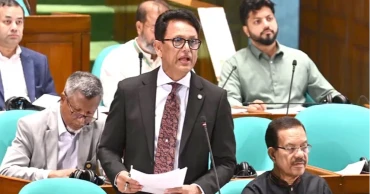
Education Minister Dr A N M Ehsanul Haque Milon on Wednesday announced that HSC examinees who were unable to attend examinations due to adverse weather or other unavoidable reasons will be allowed to sit for the missed papers.
Making a statement in Parliament under Rule 300, the minister said the special arrangement has been made considering the importance of the HSC examination in students' academic lives.
He said a total of 12, 70,583 candidates are taking the HSC and equivalent examinations this year at 2,697 examination centres across the country.
The minister said examinations have already been postponed in five districts under the Chattogram Education Board- Chattogram, Cox's Bazar, Khagrachhari, Rangamati and Bandarban due to heavy rainfall and adverse weather condition.
He added that apart from tChattogram Education Board, some candidates in Dhaka and several other districts were also unable to sit scheduled examinations because of inclement weather and various unavoidable circumstances.
"Candidates who could not participate in any subject of the ongoing HSC and equivalent examinations due to adverse weather or other unavoidable reasons will be allowed to sit those examinations on the same date and at the same time fixed by the Education Ministry for the already postponed examinations under the Chattogram Education Board," the minister told Parliament.
He said the examinations would be held using identical question papers for the relevant subjects.
The minister also updated Parliament on the controversy surrounding the Physics First Paper examination.
He said the officials responsible for preparing the erroneous question paper have already been suspended .
Reiterating the government's assurance to examinees, Milon said all candidates would receive full marks for Questions 6 and 7 of the Physics First Paper, where errors were identified.
He said the government remained committed to ensuring that no student would be affected because of mistakes in the examination process or circumstances beyond their control.
9 days ago
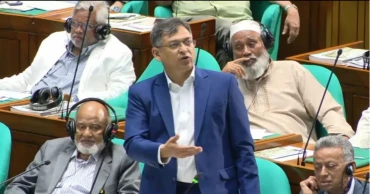
Hasina to be arrested immediately upon return: Salahuddin
Home Minister Salahuddin Ahmed on Tuesday told Parliament that the government wants former Prime Minister Sheikh Hasina to be extradited to Bangladesh under the existing extradition agreement, saying she will be arrested immediately upon her return as she has already been convicted in several cases.
"We want her to be sent back under the extradition agreement so that she faces trial," he said, participating in a discussion on the July 2024 mass uprising in Parliament.
Referring to the legal stance, Salahuddin said Sheikh Hasina will have no opportunity to surrender as she is already a convicted person. "If she returns, she will be arrested immediately, and the verdicts will be executed. If there is any scope for appeal, that will be decided by the court," he said.
The discussion was initiated after National Citizen Party (NCP) lawmaker Akhter Hossen (Rangpur-4) raised a notice under Rule 68 of the Rules of Procedure seeking a discussion on the July 2024 mass uprising and the trial of those responsible for the alleged genocide committed during the movement.
Five other NCP lawmakers – Abdul Hannan Masud (Noakhali-6), Abdullah Al Amin (Narayanganj-4), Md Abul Hasnat (Cumilla-4), Mahmuda Alam Mitu (Women Seat-46) and Nusrat Tabassum Joty (Women Seat-50) – signed the notice.
The minister said Awami League will be tried as a political party for its involvement in crimes against humanity committed during the July uprising, as investigation now continues in this regard.
To expedite the trial proceedings in cases related to crimes against humanity, he said, "If necessary, the number of tribunals, prosecutors, investigation teams and logistic support will be increased. Our foremost objective is to establish justice in this country."
Citing a UN report, Salahuddin said around 1,400 people were killed during the July uprising. However, the government believes the actual number might exceed 2,000, while around 30,000 people were injured, pledging to ensure justice for all victims.
He said the government has already announced that Prime Minister Tarique Rahman will open the July Memorial Museum on August 5 next.
The minister also said any July uprising victims requiring treatment abroad will receive priority support, while the July Foundation will continue its operations and expand services for victims and their families.
He urged all political parties not to claim exclusive ownership of the July movement. "The July uprising belongs to all Bangladeshis. We should preserve its spirit without turning it into a political tool," he said, adding that future generations should learn from the events so that no government dares to adopt fascist practices again.
Responding to criticism of some media outlets by the opposition leader, Salahuddin said freedom of speech and media freedom must be protected. “We will respond to criticism in the media through facts and democratic means," he said.
He also stressed that the government and opposition remain united on issues relating to Bangladesh's independence and sovereignty despite political differences inside Parliament.
Expressing concern over delays in the trial process, Leader of the Opposition Dr Shafiqur Rahman warned that the nation will not tolerate any procrastination in delivering justice for the July killings.
"If anyone delays the trial process, I will be a complainant against them in the hereafter," he said, underscoring the need for impartiality. “The trial must take place. But at the same time, no one should face injustice in the name of justice. The trial must be fair."
Criticising a section of the media, Shafiqur Rahman alleged that many media outlets had helped prolong the previous "autocratic regime."
"We do not know what action has been taken against those media outlets. Rather, they have again become active in spreading narratives. Some are making statements that amount to sedition, but no attention is being paid to these issues,” he said.
Referring to the referendum, the opposition leader said the people had given their verdict in favour of reforms and urged the government to positively consider and implement that public mandate.
Taking part in the discussion, Law Minister Md Asaduzzaman said there will be no legal scope for Sheikh Hasina or other convicted persons to surrender voluntarily upon returning to Bangladesh.
"They will be arrested the moment they enter Bangladesh," he said, adding that those who believe in the spirit of July will never allow the rehabilitation of what he termed the "fascist Awami League."
Opposition Chief Whip Nahid Islam, State Minister Nurul Haque and Bangladesh Jamaat-e-Islami lawmakers Mir Ahmad Bin Quasem and Rokeya Begum (Women Seat-45), also mother of martyred Jabir Ibrahim, also joined the discussion.
In the notice, Akhter Hossen said the month of July is underway. In this month of 2024, a bloody mass uprising took place in Bangladesh, through which Bangladesh was freed from the long-standing misrule of the fascist regime.
He said people from all walks of life participated in the movement, during which many were injured, permanently maimed and martyred.
“It is important to honour the sacrifice of those people and their recognition in this Jatiya Sangsad. Simultaneously, there is a need to discuss the proper trial and punishment of those who participated in the genocide in July 2024,” said Akhter Hossen.
9 days ago
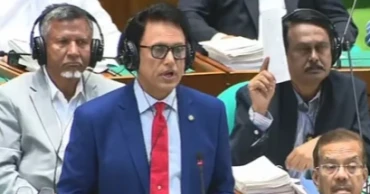
Milon regrets remarks on HSC examinees
Education Minister Dr ANM Ehsanul Hoque Milon on Tuesday expressed regret for his personal remarks about the Higher Secondary Certificate (HSC) examinees, saying he did not intend to hurt anyone.
He also announced that the government is considering retaking three examinations disrupted by heavy rain.
"I did not make any remarks with the intention of hurting anyone. If anyone has been hurt by my personal remarks, I simply express my regret," the minister said in Parliament.
He was responding to observations by Bangladesh Jamaat-e-Islami MP Md Shafiqul Islam Masud, who referred to students' demand for postponing the examinations and said they were heading towards Parliament over the issue.
The minister said the government has carefully reviewed the situation after receiving complaints from students.
He said Physics (Second Paper), Accounting and Logic examinations were held on Monday amid heavy rains, with many candidates getting soaked on their way to examination centres.
"We received complaints that many students could not sit the tests properly because of the rain," Milon said.
He also noted that all HSC examinations under the Borad of Intermediate and Secondary Education, Chattogram have already been postponed due to flooding and will have to be rescheduled.
"When we arrange the rescheduled examinations for the Chattogram board, including Physics Second Paper, Accounting and Logic, we are considering holding fresh examinations for these subjects as well, InshaAllah," the minister added.
10 days ago
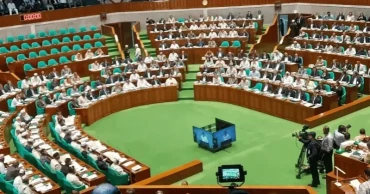
Parliament mourns death of former Qatar Emir Sheikh Hamad
Bangladesh Parliament on Tuesday unanimously adopted a condolence motion expressing profound grief over the death of former Emir of Qatar Sheikh Hamad bin Khalifa Al Thani, describing him as one of the world's most visionary statesmen and the architect of modern Qatar.
Chief Whip Nurul Islam Moni placed the condolence motion in the House, which was passed unanimously by voice vote after Deputy Speaker Kayser Kamal put it to vote.
Presenting the motion, the Chief Whip said Sheikh Hamad, who was one of the wisest and most visionary statesmen of the contemporary world, transformed Qatar into a rapidly developing, modern and prosperous nation through his visionary leadership.
“Under his leadership, Qatar became a rapidly developing, modern and prosperous state,” he said adding that his contributions to education, health, energy, infrastructure, economy, international diplomacy and human resource development placed Qatar in a prestigious position in the world.
“That is why he is recognised worldwide as the 'architect of modern Qatar,” said the chief.
Moni also highlighted Sheikh Hamad's role in strengthening the longstanding friendship between Bangladesh and Qatar.
“Under the visionary leadership of Sheikh Hamad bin Khalifa Al Thani, the friendly relations between Bangladesh and Qatar were further strengthened. His contribution to the employment of a large number of Bangladeshi expatriate workers, bilateral economic cooperation and mutual development will be particularly remembered,” he said.
With his death, Qatar has lost a great statesman and Bangladesh and the international community have lost a dedicated advocate of peace, development and cooperation, he said in the motion.
Praising the current Emir of Qatar, Tamim bin Hamad bin Khalifa Al Thani in the motion, the House said the way Qatar stood by the Bangladeshi workers with humanity, despite being in danger, during the recent Middle East crisis, has touched the hearts of the people of Bangladesh.
The copies of the condolence motion would be sent to the parliament (Shura Council) of Qatar, the Embassy of Qatar in Bangladesh and the Government of Qatar.
Sheikh Hamad bin Khalifa Al Thani, who ruled Qatar from 1995 to 2013, died on July 12 at the age of 74.
10 days ago
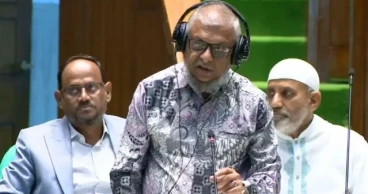
Govt plans inter-ministerial body to improve services for expatriates
The government has decided to propose the formation of an inter-ministerial committee to improve services for Bangladeshi expatriates, address harassment in passport and other essential services, and facilitate lower-cost overseas migration through legal channels.
Expatriates' Welfare and Overseas Employment Minister Ariful Haque Choudhury disclosed the plan while responding to a call attention notice raised by Independent MP Rumeen Farhana in Parliament on Tuesday.
The minister said the proposed committee comprising representatives from relevant ministries and agencies would review problems relating to passports, airport services, visas, medical examinations and other services for expatriate Bangladeshis and recommend necessary measures to ensure coordinated and hassle-free service delivery.
He said the government has been working in coordination with relevant ministries and agencies to safeguard the welfare of Bangladeshi migrants.
The process of repatriating the bodies of Bangladeshi migrant workers has been made easier since the current government assumed office.
He said the Wage Earners' Welfare Board provides assistance under its existing policy for bringing back bodies, receiving them at airports, handing them over to families, supporting burial arrangements and providing financial grants.
Through expatriate welfare desks at the country's three international airports, the government provides an immediate grant of Tk 35,000 to cover transportation and burial expenses, he added.
During the 2025-26 fiscal year, the government provided Tk 18.59 crore to the families of 5,312 deceased migrant workers, the minister said.
He also said the Wage Earners' Welfare Board operates five ambulances to transport the bodies of deceased expatriates and seriously ill returnees to their homes.
Families of migrant workers holding BMET overseas clearance or membership of the Wage Earners' Welfare Board receive Tk 300,000 in financial assistance within two months of the worker's death, he said.
The minister added that returning migrant workers suffering from illness are eligible for medical assistance of up to Tk 200,000.
He said expatriate welfare desks remain operational round the clock at airports to ensure the dignified handling and handover of deceased migrant workers. Officials from the Aviation Security, Customs authorities and the Welfare Board jointly supervise the process, he added.
On medical examinations for overseas workers, Ariful Haque said fees are fixed by the Directorate General of Health Services and that 181 medical centres have so far been enlisted by the ministry.
He said the listed medical centres are regularly monitored and action is taken against any institution found charging excessive fees or engaging in irregularities.
Responding to a supplementary question from Rumeen Farhana elected from Brahmanbaria-2, the minister said the government has already formed a committee to curb irregular migration and human trafficking through sea routes and other illegal channels.
He said the government has made significant progress in preventing irregular migration since taking office and is working to reduce migration costs so that more Bangladeshis can go abroad through legal means.
"We have undertaken initiatives to send workers overseas at lower costs. We hope we will be able to ensure overseas employment at affordable costs," he said, adding that the committee is monitoring the issue on a regular basis.
Earlier, Rumeen Farhana noted that unemployment remains a major challenge, with 2.5 to 3 million young people entering the labour market annually according to official estimates, while unofficial figures suggest the number exceeds 10 million.
She also pointed out that migration costs for Bangladeshis are significantly higher than those for workers from countries such as India and Pakistan, prompting many to attempt dangerous and irregular journeys to Europe.
The MP asked what steps the government is taking to reduce migration costs and raise awareness among prospective migrant workers to encourage them to use legal migration channels.
10 days ago

Govt expanding mother tongue education for ethnic communities: Minister
Education Minister Dr ANM Ehsanul Hoque Milon on Tuesday said the government is expanding mother tongue-based education for ethnic communities through the preservation of indigenous languages, development of textbooks and teacher training programmes.
Responding to a notice on calling attention to a matter of urgent public importance raised by BNP reserved seat MP Anna Minj in Parliament, he said protecting the languages of ethnic communities is both a constitutional responsibility and a national commitment.
Recalling past initiatives, the minister said former President Ziaur Rahman had taken a number of measures to improve education standards among ethnic communities and had also arranged for television programmes in their languages.
He added that the International Mother Language Institute, established during the tenure of former Prime Minister Begum Khaleda Zia in 2002, was entrusted with the task of preserving indigenous languages, many of which face the risk of extinction.
Milon said around 30 indigenous languages are considered endangered and the institute has been working to preserve them. “As an initial step, primary school textbooks were developed in five indigenous languages, including Chakma, Marma and Tripura.”
He said the initiative reflects Bangladesh's commitment to safeguarding every child's mother tongue in line with the spirit of International Mother Language Day.
The minister said the National Academy for Primary Education has incorporated mother tongue textbooks for ethnic communities into the weekly class routine of primary schools, and teaching activities are continuing accordingly.
He also informed Parliament that teacher training programmes in five indigenous languages began in 2026. So far, 450 teachers have been trained through 15 batches at five Primary Teachers' Training Institutes.
Milon said the National Curriculum and Textbook Board will distribute 37 new books in five indigenous languages this year to further strengthen mother tongue education.
He added that the government has also decided in principle to extend multilingual education beyond Chakma, Marma, Tripura and Santal languages under a multi-year programme.
The minister assured Parliament that ethnic communities are an integral part of Bangladesh and that the government is committed to ensuring their constitutional rights through educational opportunities and equal access to facilities available in both government and private educational institutions.
He, however, acknowledged that a shortage of teachers remains a major challenge, particularly in the Chittagong Hill Tracts.
To address the problem, the government has initiated a plan to recruit teachers locally and provide them with professional training so that children can receive education in their own communities, Milon added.
10 days ago