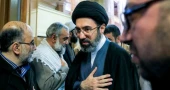
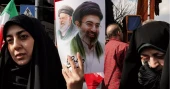
Iran’s Supreme Leader Mojtaba Khamenei
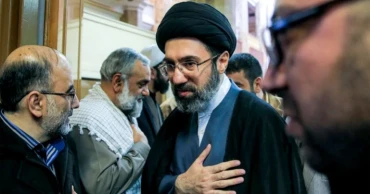
Iran’s supreme leader signals navy readiness for “bitter defeats” to rivals
Iran’s Supreme Leader Mojtaba Khamenei on Saturday said the country’s navy is ready to inflict “new bitter defeats” on the United States and Israel, according to IRNA.
In a message marking Iran’s Army Day on April 18, he praised the army’s role against what he described as “enemies.” He said during the recent 40-day war, Iranian forces “courageously” defended the country alongside other armed units, exposing the “weakness and humiliation” of the United States and Israel.
Khamenei added that as army drones “thunderously” struck U.S. and Israeli targets, “its brave Navy is ready to give the enemies the bitter taste of new defeats.”
Iran reimposes restrictions on Strait of Hormuz amid US tensions
On Feb 28, Israel and the United States carried out joint attacks on Tehran and other cities, killing then Supreme Leader Ali Khamenei, senior commanders and civilians. Iran retaliated with missile and drone strikes and tightened control over the Strait of Hormuz.
A two-week ceasefire was declared on April 8, followed by talks between Iranian and U.S. delegations in Islamabad.
Meanwhile, Deputy Foreign Minister Saeed Khatibzadeh said no date has been set for the next round of talks, despite reported progress, adding Iran will act within international law.
5 months ago
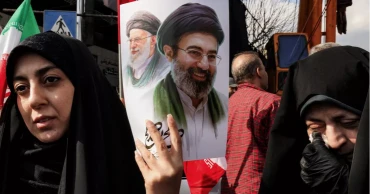
Iran to take Strait of Hormuz management to ‘new phase’, says Supreme Leader
Iran’s Supreme Leader Mojtaba Khamenei has said Tehran will take the management of the Strait of Hormuz “into a new phase,” as tensions persist over access to the critically important waterway despite a fragile ceasefire with the United States.
In a statement broadcast by state media, Khamenei said Iran would “seek compensation for every single loss inflicted” and pursue damages for those injured in the war. While he did not clarify what the new phase of Hormuz management would entail, the remarks signal a potential shift in Tehran’s strategy over the vital global oil route.
He stressed that Iran “never sought war and we’re not seeking war,” but warned it would “not back off from seeking our legitimate rights in any way,” including support for what he described as the “entire resistance front.” He also called on pro-Iran supporters to mobilise publicly, saying their voices could influence the outcome of ongoing negotiations.
Meanwhile, US President Donald Trump said Israel would “scale back” strikes on Lebanon ahead of talks with Iran in Islamabad, expressing optimism about a potential deal. However, Israeli Prime Minister Benjamin Netanyahu rejected the notion of a truce in Lebanon, declaring “there is no ceasefire” and vowing continued attacks against Hezbollah.
Netanyahu says Israel to hold direct talks with Lebanon amid ceasefire dispute
The conflicting positions have cast doubt on the durability of the two-week ceasefire, with disputes over Lebanon and the Strait of Hormuz emerging as key sticking points. Heavy Israeli strikes on Beirut shortly after the truce announcement further deepened uncertainty.
Diplomatic efforts are set to continue, with Pakistan hosting talks in Islamabad involving senior officials from the US, Iran and Pakistan, as both sides test the possibility of a broader settlement.
Pakistani officials have disclosed the names of key figures expected to attend the upcoming negotiations aimed at ending the conflict between Iran and the United States.
The talks are tentatively scheduled for Saturday in Islamabad, though officials said details are still being finalised and the list of participants may change, reports Al Jazeera.
From Pakistan, expected attendees include Prime Minister Shehbaz Sharif, Chief of Army Staff Asim Munir, Deputy Prime Minister and Foreign Minister Ishaq Dar, and National Security Adviser Asim Malik, who also heads the country’s Inter-Services Intelligence (ISI).
The US delegation is likely to feature Vice President JD Vance, Special Envoy Steve Witkoff, senior presidential adviser Jared Kushner, and Admiral Brad Cooper, head of the US Central Command (CENTCOM).
Iran’s side is expected to be represented by Speaker of Parliament Mohammad Bagher Ghalibaf, Foreign Minister Abbas Araghchi, and Deputy Foreign Minister Majid Takht-Ravanchi.
Officials emphasised that the final list of participants could be updated as preparations continue. The talks come amid a two-week ceasefire between Iran and the US, providing a window for diplomatic engagement.
With inputs from BBC
6 months ago