Media Commission
Govt to form advisory committee for media commission
The government has decided to form an advisory committee to facilitate the formation of a media commission, leaders of the Editors’ Council said after a meeting with Prime Minister Tarique Rahman on Sunday.
The decision came during a meeting between the Prime Minister and leaders of the Editors’ Council at the Cabinet Division’s Public Administration conference room at the Secretariat.
Speaking to reporters after the one-and-a-half-hour closed-door meeting, Editors’ Council President and New Age Editor Nurul Kabir said they had a detailed discussion with the Prime Minister on the existing media environment and laws affecting the sector.
He said they informed him about the undemocratic aspects within the existing laws and regulations related to the media and agreed that many of those issues need to be reviewed.
“We have agreed to form a consultative committee comprising all relevant stakeholders to establish a democratic media regime in Bangladesh. The committee will work throughout June and prepare a final report sometime in July, based on which we will formulate a democratic media law,” the New Age Editor said.
Nurul Kabir said the Editors’ Council also discussed ways to overcome various problems and unhealthy practices in the media sector.
“We assured the government that as long as it behaves democratically, the editors will remain engaged with them,” he said adding that the government welcomed the proposal.
Nurul Kabir said misinformation and disinformation on social media and other platforms are harming all sections of society, including journalists.
“We want to work together to remove the barriers that stand in the way of building credibility, trust and public confidence in the media,” he said.
The Daily Star Editor Mahfuz Anam told reporters that they handed over a list to the Prime Minister.
“We informed him that around 282 journalists are facing different kinds of cases, and among them, 94 have been made accused in murder cases. We submitted the list to the Prime Minister. I would not say the list is fully complete; there may still be omissions. But we prepared it with sincere efforts,” he said.
Mahfuz Anam said the Prime Minister accepted the list and asked the Information Minister to look into the matter and take necessary initiatives.
“We strongly said that filing murder and other cases against journalists is not good for the environment of a democratic country. It is also not good for the image of the government,” he said.
Asked what the Prime Minister said on the issue, he replied, “He took the matter very sincerely and said they would examine it. They are interested in addressing the issue.”
Editors’ Council leaders said the advisory committee would consult stakeholders.
They said discussions at the meeting also covered strengthening the Press Council, withdrawal of cases filed against journalists, clearing outstanding advertisement dues of newspapers, updating the existing conditions for newspaper declarations, media freedom, journalists’ professional safety and various challenges and prospects of the newspaper industry.
Several important policy decisions were also taken at the meeting, including steps to make the Press Council more independent, effective and stronger.
Leaders of the Editors’ Council thanked the Prime Minister and said journalists did not faced any obstruction in carrying out their professional duties during the government’s first three months in office.
The Prime Minister later hosted a lunch for the journalists.
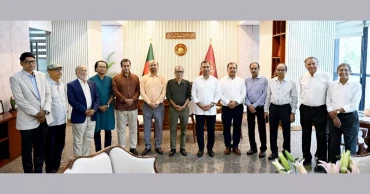
After the meeting, members of the Editors’ Council took a group photograph with him.
Editors’ Council President and New Age Editor Nurul Kabir, General Secretary and Banik Barta Editor Dewan Hanif Mahmud, The Daily Star Editor and Publisher Mahfuz Anam, Prothom Alo Editor and Publisher Matiur Rahman, Manabzamin Chief Editor Matiur Rahman Chowdhury, Financial Express Editor Shamsul Huq Zahid, Inqilab Editor AMM Bahauddin, Suprobhat Bangladesh Editor Rusho Mahmud and Karatoa Editor Mozammel Haque attended the meeting.
Information and Broadcasting Minister Zahir Uddin Swapon, State Minister Yasser Khan Choudhury and Prime Minister’s Information Adviser Dr Zahed Ur Rahman were among the attendees.
4 months ago
Govt starts process to form Media Commission to strengthen media freedom, accountability: Information Minister
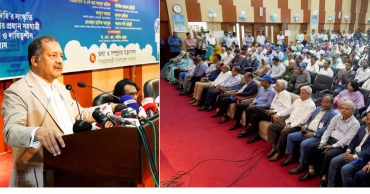
Information and Broadcasting Minister Zahir Uddin Swapon on Sunday said the government has initiated the process of forming a strong Media Commission aimed at building an independent and responsible media framework in the country.
“Regulation does not mean control; rather, the government wants to play the role of a facilitator in ensuring a healthy and normal environment,” the minister said at a discussion, marking the World Press Freedom Day, 2026 at the ministry in the capital.
This year’s Bangladesh theme for the observance of the day is: “Independent and Responsible Media: A Key Partner in Establishing a Culture of Accountability.”
The minister said the media sector is a vast and complex system and that the government does not want to impose decisions unilaterally.
“We will form an advisory committee involving representatives from all sides under the leadership of a widely accepted media expert. Based on the committee’s well-considered recommendations, a permanent Media Commission will be established. We believe this will ensure full freedom and protection for the media,” he said.
He said the initiative would be implemented through continued dialogue with the Editors’ Council, journalists’ organisations, media owners and other relevant stakeholders.
Reaffirming the government’s commitment to journalists’ professional safety and legal protection, the minister said no journalist would be jailed without committing an offence.
“As a matter of policy, the government will ensure professional protection for all journalists under the law. Defamation cases and other legal complexities will be brought under institutional management through the Press Council,” he added.
Zahir Uddin said the global media landscape is currently passing through a complex reality where journalists face growing risks in conflict zones while the rapid expansion of digital platforms, social media and artificial intelligence (AI) is transforming the nature of information flow.
“As a result, new challenges surrounding the media have emerged, and these can no longer be addressed through conventional thinking,” he said.
He said the issue of media freedom and responsibility remains highly significant and the government wants to build an independent, strong and responsible media system in the country.
The minister said the government does not believe in interfering in the media and reiterated its commitment to fearless, objective and unbiased journalism.
To combat the spread of misinformation and disinformation in the digital era, he emphasised the need for strong fact-checking mechanisms within every media organisation.
“No news should be published without verification and institutional mechanisms must be developed for this purpose,” he said.
He also noted that the media is not merely a business or industry but a crucial component in maintaining balance within the state and society, adding that the sector would receive necessary policy support and patronage.
Speaking at the event, Bangladesh Press Council Chairman Justice A K M Abdul Hakim said efforts are underway to make the Press Council more effective in ensuring journalists’ professional rights and legal protection.
“Without media freedom, democracy and the rule of law cannot be established. However, accountability must accompany freedom. Rights are inseparably linked with duties and responsibilities. Ignoring limits and jurisdictions in many cases can create disorder in society. Journalists must maintain high ethical standards and professional discipline,” he said.
S M Shamim Reza, professor of the Department of Mass Communication and Journalism at University of Dhaka, presented the keynote paper at the event.
Among the speakers at the discussion were Matiur Rahman Chowdhury, president of the Newspapers Owners Association of Bangladesh (NOAB) and Editor-in-Chief of Manabzamin; Abdus Salam, secretary general of Association of Television Channel Owners (ATCO) and chairman of Ekushey Television; Dewan Hanif Mahmud, general secretary of the Editors’ Council and editor of Bonik Barta and Hasan Hafiz, president of the Jatiya Press Club.
Additional Secretary of the Ministry of Information and Broadcasting Md Shah Alam delivered the welcome speech at the programme.
Earlier in the morning, a colourful rally was organised to mark World Press Freedom Day 2026.
Senior officials from the Ministry of Information and Broadcasting and its affiliated departments and agencies joined the rally.
5 months ago