hantavirus outbreak
What is hantavirus and how does it spread?
A cruise ship linked to a hantavirus outbreak has reached the Canary Islands after several passengers and crew members were connected to confirmed and suspected infections.
The outbreak aboard the MV Hondius has so far been tied to three confirmed cases and five suspected ones.
Among the confirmed cases are a Dutch woman who died, a British passenger receiving intensive care treatment in South Africa and a Swiss passenger being treated in Zurich, reports BBC.
Suspected cases include a British national, a Dutch crew member and a German passenger. Two of them have been transferred to the Netherlands for treatment, while another remains in stable condition aboard a delayed evacuation flight.
Although none of the suspected cases have tested positive yet, two individuals have shown symptoms associated with the virus.
Two British passengers who left the ship earlier during its Atlantic voyage from Argentina to Cape Verde are currently isolating at home in the UK after possible exposure. According to the UK Health Security Agency, neither has developed symptoms.
Meanwhile, health officials in the US states of Arizona and Georgia said they are monitoring three American passengers who disembarked before the vessel arrived in Cape Verde. None have shown signs of illness.
Passengers remaining on board are undergoing medical assessments and are leaving the ship in stages based on nationality. Several Spanish and French travellers have already returned home, while countries including the UK have arranged special flights for their citizens.
What is the Andes strain of hantavirus?Hantavirus refers to a group of viruses rather than a single disease. The virus family takes its name from a river in South Korea.
The World Health Organisation (WHO) says there are more than 20 hantavirus species, most of which are transmitted to humans through exposure to infected rodents such as rats and mice, especially via dried urine and droppings.
One particular variant — the Andes strain — is believed capable of spreading between humans, though such transmission is considered rare.
South African health authorities confirmed that the British passenger being treated in Johannesburg and the Dutch woman who died were infected with the Andes strain.
The Andes virus is commonly found in Argentina and Chile. A major outbreak in Argentina in 2018 was linked to a social gathering where one infected individual is believed to have transmitted the virus to 34 people, resulting in 11 deaths.
How does this affect response measures?The confirmation of the Andes strain has increased concerns that transmission may have occurred through close human contact on the ship in addition to possible exposure to rodents.
As a precaution, passengers remaining aboard the vessel are being confined to their cabins to reduce contact. British nationals returning home are also expected to self-isolate.
A WHO physician on board reported that no additional passengers had developed symptoms as of Saturday.
Health experts say containing the outbreak will depend on strict measures including isolating infected individuals, monitoring close contacts, maintaining hand hygiene and following infection-control procedures.
The exact source of the outbreak remains unclear. Earlier WHO findings suggested the first infected passengers had travelled through Argentina, Chile and Uruguay during a bird-watching tour that included areas inhabited by rodents known to carry the virus.
Despite the outbreak, specialists say the overall risk to the global population remains very low, with no evidence so far of spread beyond the cruise ship.
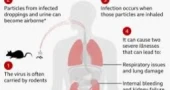
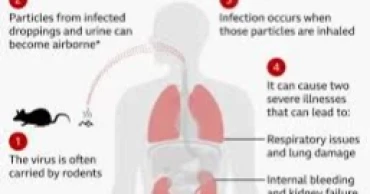
How does hantavirus spread?Hantavirus is usually transmitted through contact with rodent saliva, urine or droppings.
People often become infected after inhaling virus particles that become airborne when contaminated rodent waste is disturbed.
Infections can also occur through rodent bites.
The Andes strain is currently the only known hantavirus capable of spreading between humans, and even then transmission is uncommon.
Experts say person-to-person spread generally requires prolonged and close interaction with someone showing symptoms.
WHO officials note that the virus does not spread in the same way as influenza or Covid-19, which are transmitted more easily through coughing or sneezing.
What are the symptoms and how dangerous is it?Hantavirus can lead to two serious illnesses.
The first is Hantavirus Pulmonary Syndrome (HPS), which initially causes symptoms such as fever, fatigue and muscle pain. Patients may later experience headaches, chills, dizziness and abdominal problems.
In severe cases, breathing difficulties can develop rapidly, requiring urgent medical care. The Andes strain is commonly associated with HPS, which carries a fatality rate of between 20 and 40 percent.
The incubation period can range from one to eight weeks, making early detection more difficult.
The second illness is Haemorrhagic Fever with Renal Syndrome (HFRS), which begins with flu-like symptoms but can progress to kidney damage, internal bleeding, low blood pressure and acute kidney failure.
Is there a vaccine or treatment?There is currently no specific cure for hantavirus infections, although prompt medical treatment can improve survival chances.
Supportive care may include oxygen therapy, ventilator support and dialysis for patients with kidney complications.
Severely ill patients often require treatment in intensive care units.
Researchers are also testing potential new treatments.
No widely available vaccine exists yet, although some vaccines targeting local hantavirus strains are being used in China and South Korea.
5 months ago