radioactive waste problem Japan
Japan's nuclear restart raises concerns over growing radioactive waste problem
Japan's decision to restart the world's largest nuclear power plant to help meet rising electricity demand has renewed concerns over a long-standing challenge: the country is running out of storage space for spent nuclear fuel and still lacks a permanent solution for disposing of radioactive waste.
The No. 6 reactor at the Kashiwazaki-Kariwa Nuclear Power Station resumed operations earlier this year, marking a key step in the government's effort to bring more nuclear reactors back online. However, industry officials warn that spent fuel storage capacity is becoming a serious issue.
According to the Federation of Electric Power Companies of Japan, cooling pools at Kashiwazaki-Kariwa and two other nuclear plants could reach full capacity within the next five years.
"Without a clear fuel management strategy, power generation could eventually face obstacles," said Takeyuki Inagaki, general manager of the Kashiwazaki-Kariwa plant.
Japan has spent decades searching for a permanent disposal site for highly radioactive nuclear waste. The government is now considering Minamitorishima, a remote Pacific island about 2,000 kilometers south of Tokyo, as a possible location. The proposal, however, has sparked criticism and public concern.
Only 15 of Japan's 54 nuclear reactors have resumed operations since the 2011 Fukushima disaster, when a powerful earthquake and tsunami triggered meltdowns at three reactors, forcing around 160,000 people to evacuate. Some affected areas remain uninhabitable.
The Kashiwazaki-Kariwa plant, also operated by Tokyo Electric Power Company Holdings (TEPCO), was shut down after the Fukushima accident as part of a nationwide suspension of nuclear power operations.
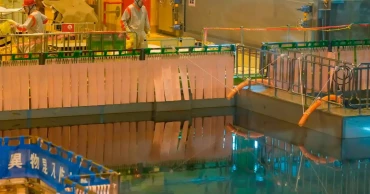
At the restarted No. 6 reactor, the spent fuel storage pool is already about 88 percent full. TEPCO says it has added new safety systems, including filtered vents and measures to prevent hydrogen explosions, based on lessons learned from Fukushima.
Prime Minister Sanae Takaichi's government is promoting greater use of nuclear energy, but critics warn that bringing more reactors online will also increase the amount of radioactive waste. Without a permanent disposal plan, some reactors may eventually face closure due to limited storage capacity.
Recycling strategy faces hurdles
Japan's nuclear policy focuses on recycling spent fuel to recover plutonium and uranium for reuse, arguing that the approach supports energy security while reducing waste volume.
However, the recycling programme has faced repeated setbacks. A reactor intended to use recycled plutonium has struggled, while reprocessing facilities are not expected to handle all existing spent fuel. Critics also point to Japan's large stockpile of plutonium, which experts say is already sufficient to produce thousands of nuclear weapons.
Some specialists argue that Japan should also seriously consider direct disposal of spent fuel as an alternative.
Government data show that by the end of 2025, spent fuel storage pools at 17 nuclear power plants contained more than 17,000 tons of spent fuel, filling nearly 80 percent of their total capacity.
Experts note that Japan must not only manage routine nuclear waste but also deal with the enormous amount of radioactive material generated by the Fukushima disaster.
Environmental politics expert Lila Okamura of Senshu University said selecting and developing a final disposal site would be a project spanning generations, requiring careful planning and long-term monitoring.
Remote island proposal sparks debate
Shortly after the restart of the Kashiwazaki-Kariwa reactor, Industry Minister Ryosei Akazawa requested a feasibility study on using Minamitorishima as a final disposal site for high-level radioactive waste.
Akazawa described final disposal as a critical national issue as spent fuel continues to accumulate across the country.
The island is government-owned and has no permanent residents. It is also strategically important because Japan is developing military facilities there and the surrounding seabed contains valuable rare earth minerals.
Supporters argue that the island's stable geology could make it suitable for long-term waste storage. However, residents of nearby islands and local officials have raised concerns about safety, environmental risks and potential impacts on tourism.
Critics say the proposal appears politically convenient because the island's remote location is unlikely to generate strong local opposition.
Japan has struggled for years to find a community willing to host a nuclear waste disposal facility despite offering substantial government subsidies. Minamitorishima is only the fourth site to enter the feasibility study stage since the search began in the early 2000s.
The review process could take around 20 years before a final decision is reached.
Meanwhile, countries including Britain, Germany and the United States have largely moved away from fuel reprocessing because of high costs and technical difficulties. Finland is expected to open the world's first permanent underground disposal facility for spent nuclear fuel later this year.
For now, TEPCO is shifting spent fuel to other reactors with available storage space and hopes to resume shipments to a dry-cask storage facility in northern Japan. Several other utilities are also planning additional storage facilities.
Still, many residents remain worried about the growing volume of radioactive waste.
Civil activist Mie Kuwabara from Niigata questioned where the spent fuel would ultimately end up.
"It is irresponsible to restart more reactors and generate additional spent fuel before deciding where it will finally be stored," she said.
Kuwabara also voiced concerns about the Minamitorishima proposal, saying its remoteness should not be used as a reason to place a radioactive waste facility there.
"It's frightening to think a site could be chosen simply because there are few people around to object if something goes wrong," she said.
1 day ago