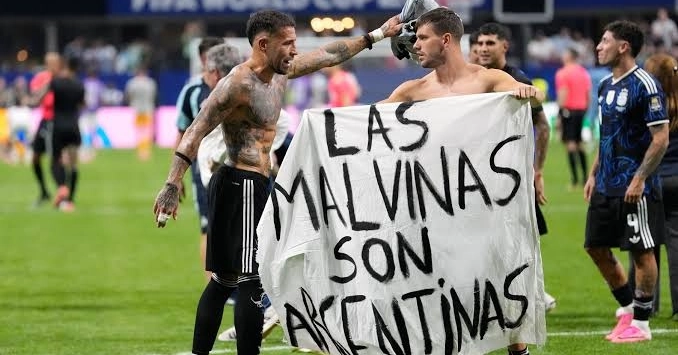
The British government has called on FIFA to investigate Argentina's national football team after its players celebrated a World Cup semifinal victory while holding a banner asserting Argentina's claim over the disputed Falkland Islands.
Argentina defeated England 2-1 in the World Cup semifinal in Atlanta on Wednesday. During the post-match celebrations, players displayed a banner handed to them by supporters that read, "Las Malvinas son Argentinas" ("The Malvinas are Argentine").
Argentina refers to the Falkland Islands as Islas Malvinas. The islands became the focus of a 10-week war in 1982 after Argentina's military government invaded the British-controlled territory. Britain regained control following the conflict.
UK Business Secretary Peter Kyle described the players' actions as "entirely inappropriate" and said he expected FIFA to conduct a thorough investigation.
Under FIFA's disciplinary code, political, ideological, religious or offensive messages displayed at stadiums are prohibited. Violations can result in fines ranging from $5,000 to $20,000. FIFA had not commented on the matter as of Thursday.
Argentina defender Lisandro Martínez said the banner carried strong emotional significance.
"I can imagine a Malvinas war veteran seeing that banner and crying," said Martínez, who has played for Manchester United in England for the past four years. "I don't know whether there will be sanctions, but the message simply expressed our belief that the islands belong to us."
Long-running political dispute
The Falkland Islands are a British Overseas Territory with a population of around 3,500 people. They are located about 480 kilometres off Argentina's coast and nearly 13,000 kilometres from Britain.
Argentina maintains that Britain illegally took control of the islands in 1833. Britain says its claim dates back to 1765 and that it expelled Argentine forces attempting to establish sovereignty over the territory in 1833.
The 1982 Falklands War claimed the lives of 649 Argentine troops, 255 British military personnel and three islanders.
The conflict coincided with the 1982 FIFA World Cup in Spain, where Argentina, England, Scotland and Northern Ireland all competed. British broadcasters declined to televise Argentina's opening match of the tournament, in which the defending champions lost to Belgium.
Argentina midfielder Leandro Paredes said the banner reflected a painful chapter in his country's history.
"It is a sad part of our history for everyone involved, and it still hurts," he said. "We knew we were playing for them as well."
FIFA's political neutrality under scrutiny
Kyle told the BBC that politics should remain separate from football, adding that the issue was now FIFA's responsibility.
FIFA's commitment to political neutrality has faced renewed scrutiny during this World Cup. Critics have questioned decisions by FIFA President Gianni Infantino and the governing body's disciplinary panel, particularly after United States forward Folarin Balogun was allowed to play against Belgium in the round of 16 despite receiving a red card in the previous match.
Under FIFA rules, Balogun should have been suspended for the next game, but the ban was postponed for one year on probation. Belgium went on to beat the United States 4-1 and advance to the quarterfinals.
Infantino is expected to attend Sunday's World Cup final between Argentina and Spain in East Rutherford, New Jersey, alongside US President Donald Trump and Argentine President Javier Milei.
Similar incidents in the past
Argentina's players displayed the same "Las Malvinas son Argentinas" slogan during a World Cup warm-up match in Buenos Aires in 2014. FIFA later fined the Argentine Football Association 30,000 Swiss francs (about $37,000) after that tournament.
In another case, South Korean footballer Park Jong-woo received a two-match FIFA suspension after displaying a banner reading "Dokdo is our territory" following South Korea's victory over Japan in the bronze medal match at the 2012 London Olympics.
More recently, during the 2022 World Cup, FIFA fined Serbia's football federation 20,000 Swiss francs (about $24,800) after a political banner showing Kosovo as part of Serbia and carrying the slogan "No Surrender" was displayed in the team's dressing room before a match against Brazil.